
SimTigrate Designs for the Future of Healthcare Environments
Experiencing is understanding. However, some problems, policies, and proposed designs that affect our health and well-being are difficult to test in real-world settings. The Georgia Tech SimTigrate Design Center closes this gap by providing a dedicated place for interdisciplinary research to address real-life challenges, such as design for aging, design for infection control, primary care teamwork, and healthy communities.
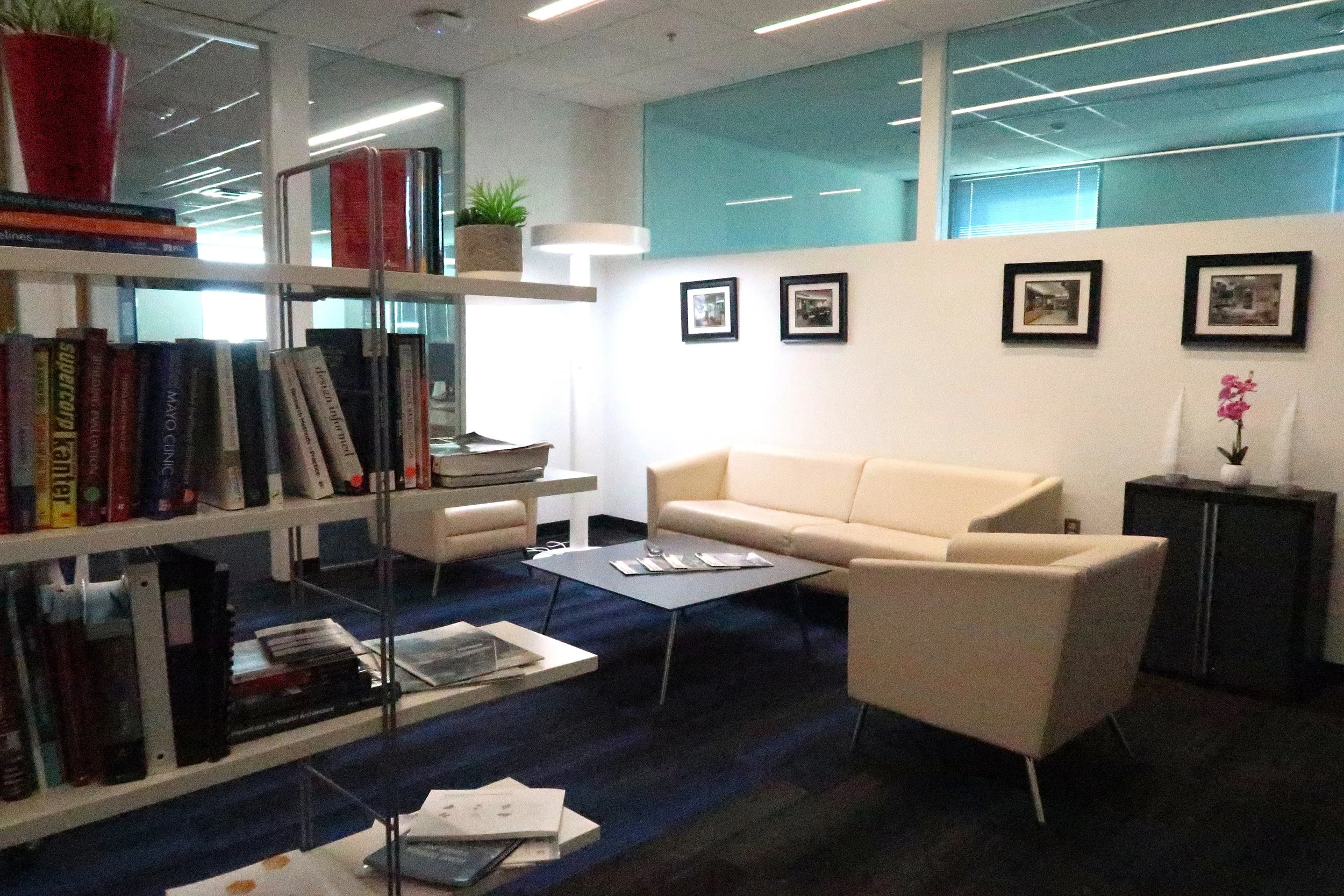
The 5,000 sq. ft. research lab includes both physical and virtual mock-up testing spaces, the Lighting User Experience (L[UX]) Lab, a full-scale virtual reality (VR) studio, and various collaboration areas. At the SimTigrate Design Center, interdisciplinary researchers conduct evidence-based research and simulations to examine how the design of devices, products, the built environment, and policies could affect medical experiences, patient safety, and health outcomes.
The SimTigrate Design Center is part of Georgia Tech’s College of Design, the Institute for People and Technology (IPaT), and the Institute of Neuroscience, Neurotechnology, and Society (INNS). It is led by Executive Director Dr. Hui Cai, a Professor of Architecture, and core faculty Dr. Eunhwa Yang, an Associate Professor of Building Construction with research expertise in environmental psychology, workplace environment, and indoor environment quality (IEQ) and Dr. Leandro Tonetto, an Associate Professor of Industrial Design, with expertise in subjective well-being and patients’ experience.
![The SimTigrate Design Center includes both physical and virtual mock-up testing spaces, the Lighting User Experience (L[UX]) Lab, a full-scale virtual reality (VR) studio, and various collaboration areas. Source: Pearl Kaplan.](https://images.squarespace-cdn.com/content/v1/547c8400e4b04456c82aade5/1769631222614-3EFN2VZDA573WJWYJDFJ/IMG_3656.png)
![The SimTigrate Design Center includes both physical and virtual mock-up testing spaces, the Lighting User Experience (L[UX]) Lab, a full-scale virtual reality (VR) studio, and various collaboration areas. Source: Pearl Kaplan.](https://images.squarespace-cdn.com/content/v1/547c8400e4b04456c82aade5/1769626903633-FOF162XGWLAQG8P8R63W/IMG_3661.JPG)
![The SimTigrate Design Center includes both physical and virtual mock-up testing spaces, the Lighting User Experience (L[UX]) Lab, a full-scale virtual reality (VR) studio, and various collaboration areas. Source: Pearl Kaplan.](https://images.squarespace-cdn.com/content/v1/547c8400e4b04456c82aade5/1769626894235-T2IK4LLPMZ2NOA34INVJ/IMG_3650.JPG)
![The SimTigrate Design Center includes both physical and virtual mock-up testing spaces, the Lighting User Experience (L[UX]) Lab, a full-scale virtual reality (VR) studio, and various collaboration areas. Source: Pearl Kaplan.](https://images.squarespace-cdn.com/content/v1/547c8400e4b04456c82aade5/1769626895664-QOY9HCY96UWCSFMRS27N/IMG_3651.JPG)
Design Provides a Window into Experience and Empathy
Source: Georgia Tech College of Design.
The study of healthcare environments and evidence-based health care design brings together the fields of design, architecture, the built environment, and healthcare. “I encountered healthcare design when I was working with Dr. Craig Zimring and Jennifer DuBose, the co-founders of the SimTigrate Design Center,” said Cai. “I was introduced to the approach of evidence-based design that is research and data-driven, centered on the needs of patients and their families, as well as staff, and rigorous in its process and design. I fell in love with this field,” adds Cai.
Cai shared an inspiring, foundational study that brought together architecture and evidence-based design research: Roger Ulrich’s 1984 publication, “View Through a Window May Influence Recovery from Surgery.” Ulrich’s work reports on the measurable outcomes of patients recovering from surgery when in rooms with windows offering a view of nature, compared with rooms with a view of a brown brick wall. “This study showed the clear impact that healthcare architecture can have for patients and their families,” says Cai.
Integrating Different Views: Designing with Collaboration in Mind
Grounded in this evidence-based and empathetic view of supporting patients, the SimTigrate Design Center has 20 years of experience co-designing and co-developing research settings and processes to improve health in home, day program spaces, outpatient, and acute care research settings.
The power of the SimTigrate Design Center as a collaborative hub is that researchers from different domains can simulate, explore, and solve healthcare design scenarios and problems together. Instead of different researchers looking at design problems from only their own perspectives, they can directly share their observations and expertise with those with other areas of expertise. “What’s really important is that we’re each looking at healthcare efficiency from our own angle, but now we are looking at the same problems together and developing more integrated solutions,” said Cai.
Supporting students and fostering relationships with community partners are two foundational elements at SimTigrate Design Center. Students from different academic domains have engaged in projects focused on observing the impact of horticulture therapy sessions on nursing home residents’ moods, studying nurses' hand hygiene compliance, and exploring rural health trends.
The SimTigrate Design Center’s full-time staff and core faculty help students and research teams, including to develop evidence-based design solutions, identify common interests for research projects, and helping to make connections with community partners. To account for the increasing complexities in our healthcare systems and environments, SimTigrate Design Center collaborates with various external partners, including non-profit organizations, health systems, industry, and architecture firms.

Expanding the Window of Possibility
A new project that highlights the values of interdisciplinary collaboration, evidence-based methods, and empathy for improving the patient experience is the exploration of how to create an integrated home system to provide continuing care during the transition from hospital to home. This project aims to develop a prototype for an Integrated Smart Transitional Home lab to support stroke rehabilitation patients’ transition to home, and the team includes experts from the Center for Inclusive Design and Innovation (CIDI), SimTigrate Design Center, the Shepherd Center, and Aware Home from IPaT.
“It’s amazing to see the interdisciplinary learning between computer scientists/engineers, physical therapists, occupational therapists, speech therapists, assistive technology experts, and user experience and usability experts, as well as architects, industrial designers, and building construction engineers,” said Cai. This new project is supported by a seed grant from the Georgia Tech Institute for Neuroscience, Neurotechnology, and Society (INNS).
The abundance of health data sources being collected also provides opportunities for new projects and collaborations. For example, brain activity, heart rate, and long-term activity data can be integrated and analyzed to gain a comprehensive understanding of a person’s health. “Person-centered research is interesting, as it can provide approaches that are more tailored for individual needs,” said Cai. “In the future, at SimTigrate Design Center we are looking forward to leveraging big data and longitudinal data to create more individualized design recommendations, integrating the built environment, technology, process, lifestyle, and healthcare/medicine.”
Interested in learning more about the SimTigrate Design Center?

Georgia Tech Spring 2025 Senior Capstone Studio - Grady Crestview Rehabilitation Center Design. Source: SimTigrate Design Center.
If you are a student, researcher, or community partner interested in collaborating or taking a tour, please email simtigrate@design.gatech.edu. You can also learn more about collaborating or visiting the SimTigrate Design Center, located on the 3rd floor of the Tech Square Research Building.
If you are a Georgia Tech student, you can engage with SimTigrate Design Center and health-related design in courses such as Healthcare Design of the Future (ARCH 4802/ARCH6271/ID 8803), Evidence-Based Design (ARCH 6243), and Architecture Design Studio 7 (ARCH 4017). And if you are conducting research at SimTigrate Design Center, consider to share your story.