
PuffEM Takes a New Approach to Vaping Research
Vaping has become widespread, especially among young adults, but researchers still lack reliable tools to measure how much people actually vape, when they vape, and how nicotine intake changes over time. Self-reported data remains the norm, despite being inaccurate and difficult to scale. At Georgia Tech’s Uncommon Senses Lab in TSRB, a team of researchers led by Dr. Alexander Adams is tackling that gap with a device designed to blend into everyday use while quietly collecting precise data.
The result is PuffEM, a sleeve that slides onto common e-cigarettes and estimates nicotine intake by sensing electromagnetic fields produced during a puff. The system recently appeared as a peer-reviewed short paper at the ACM/IEEE Conference on Connected Health, marking a step forward for both vaping research and data-driven public health interventions.
A Sleeve That Sees Every Puff
PuffEM builds on earlier work from the lab, including the PuffPacket, which integrated sensors inside a single vape device. That approach worked, but only for tightly controlled hardware. PuffEM pushes in a different direction.
“The goal was to make something wireless and adaptable,” said Rishabh Goel, a PhD student in robotics whose background is in electrical engineering and sensing systems. “We did not want a device that had to be customized for every single vape model or required access to the internals of the device.” Goel is also part of the Ka Moamoa Lab at Georgia Tech under Dr. Josiah Hester.
Instead, PuffEM uses a magnetometer placed on the surface of the vape. When a user inhales, the heating coil inside the e-cigarette draws current. That current generates an electromagnetic field, which PuffEM detects. Harder puffs generate stronger signals. Over time, those signals form a reliable proxy for puff count, puff intensity, and estimated nicotine consumption.
Yiyang (Diana) Wang is a PhD student in computer science working at the intersection of ubiquitous computing and human-AI interaction. She joined the lab and project after completing a master’s degree at Carnegie Mellon.
“For a long time, vaping research has relied on people remembering and reporting their own behavior,” Wang said. “That creates a lot of uncertainty, especially if you care about long-term patterns.”
For Wang, the motivation is personal. Her father was a smoker, and she sees PuffEM as infrastructure for future interventions rather than a tool aimed at judgment or enforcement. “This is about creating reliable data so researchers and clinicians can actually understand behavior,” she said. “Once you have that, you can start designing meaningful interventions.”
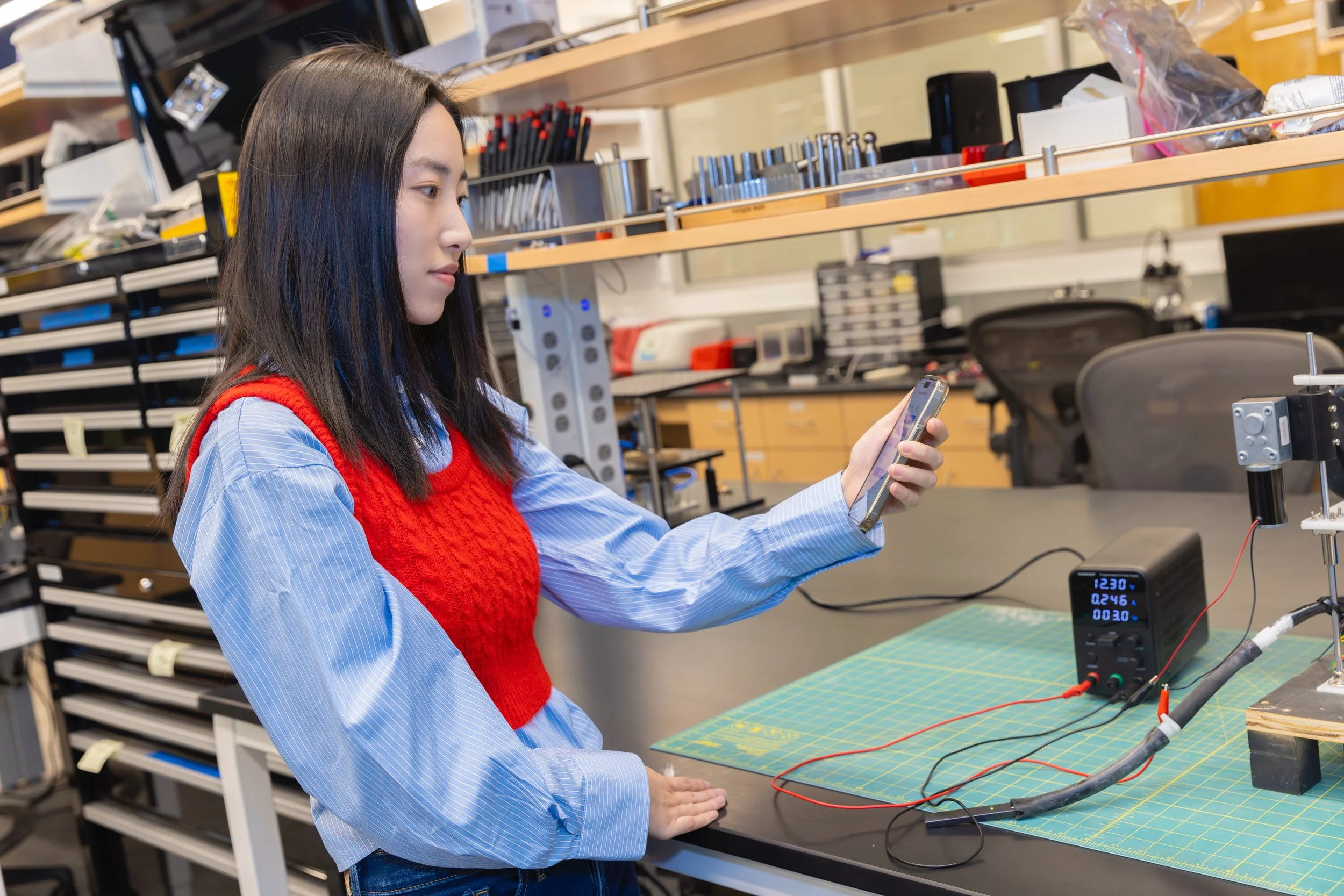
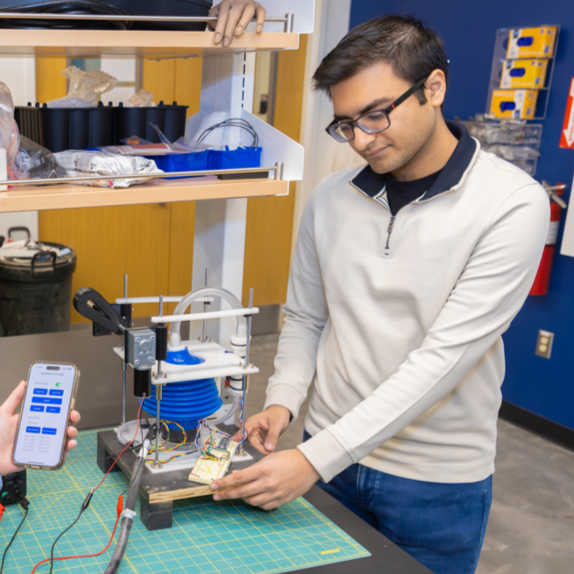
The team designed PuffEM with several constraints in mind. It needed to detect vaping accurately without false positives. It needed to work across multiple e-cigarette brands. It needed to operate for days at a time without frequent charging. It also needed to minimize burden on users so it would not change how people vape.
Real-World Testing Yields Promising Results
In lab testing, PuffEM successfully detected puffs across three popular e-cigarette devices (JUUL, Vapresso, Caliburn). The system showed a strong linear correlation between the magnetic signal it recorded and the amount of liquid vaporized, which allowed researchers to estimate nicotine intake. In other words, PuffEM did not just count puffs. It measured intensity.
The researchers then tested the system in a five-day pilot study with two participants using their devices in real-world conditions. Over that period, PuffEM recorded 753 puffs across 41 vaping sessions. Participants rated the system as highly usable and low burden, an important signal for research tools intended for longitudinal studies.
“Five to seven days is often the minimum window you need to study behavior meaningfully,” Goel said. “If a device is uncomfortable or unreliable, people will not use it that long.”
The mobile app connected to PuffEM adds another layer. In addition to collecting sensor data, it can prompt brief surveys tied to moments of use, capturing context around stress, cravings, and environment. Over time, that pairing of behavioral and contextual data could support just-in-time adaptive interventions, where support arrives when it is most relevant.
Navigating Challenges and Constraints
The work encountered some real constraints. PuffEM performs best with pen-style e-cigarettes. Bulky devices with thick housings or complex materials increase the distance between the sensor and the coil, weakening the signal. Magnetometer placement matters, and poor assembly can degrade performance.
These limits are not lost on the team. Future iterations may explore motion sensing to detect when devices are passed between users, or design changes that provide clearer feedback without drawing attention. The broader objective remains consistent.
“At the end of the day, PuffEM is a monitoring tool,” Wang said. “The ultimate goal is reducing harm by giving researchers and clinicians better information about what is actually happening.”
Future Work and Impact
That long-term vision now extends beyond Georgia Tech. The device has moved into clinical trials at Northwestern University, where researchers are focusing on how PuffEM data correlates with health outcomes. As those studies progress, the system could find applications beyond academic research, including public health partnerships, digital therapeutics, or commercialization pathways that connect hardware, software, and intervention design. The broader ambition remains consistent: build reliable behavioral measurement infrastructure that makes harm reduction strategies more precise and effective.