
Turkish Shuttle Technology Makes Debut in Atlanta With Beltline Pilot
Editor’s Note: This article was originally published by Global Atlanta and was produced with underwriting support from the Pendleton Group. Check out the original article here.
A Turkish electric shuttle technology has made its U.S. debut on the Atlanta Beltline with the launch of a pilot project linking the transformative trail project and MARTA’s established rail network.
The project known as ATL Spoke launched on June 5, a week ahead of the World Cup in Atlanta, with small autonomous buses ferrying passengers every 12 to 15 minutes between the West End MARTA station and two stops in the Lee + White mixed use district, with one stop along the way.
The 12-month pilot is free to passengers for the duration, allowing riders to test the ADA-compliant 12-person shuttles daily, with extended hours on Atlanta’s eight match days.
Turkish mobility provider Karsan’s e-JEST shuttles were incorporated into the bid from Beep, an autonomous transit provider that is operating the system and monitoring it remotely. Each vehicle is also manned by a trained onboard attendant who can answer questions and ensure smooth operations.
The installation comes amid heated debate about the future of transit along the Atlanta Beltline, which in June also marked a key milestone upon the completion of 17 miles of continuous trail in a U-shape along its southern perimeter, 20 years after it broke ground. Just five miles along the northern end of the loop are yet to be built out.
Some transit proponents argue that light rail along the route would help the Beltline reach its potential as an instrument for transit inclusion rather than gentrification; others say streetcars are outdated and would ruin the character of the trail, or that technology is moving too fast to deploy expensive fixed infrastructure.
“Atlanta is a forward-thinking community and a great place for this pilot project. It’s an important step in demonstrating what autonomous transit can look like at scale for cities across the country and world,” said Clayton Tino, president and chief operating officer of Beep, said in a news release.
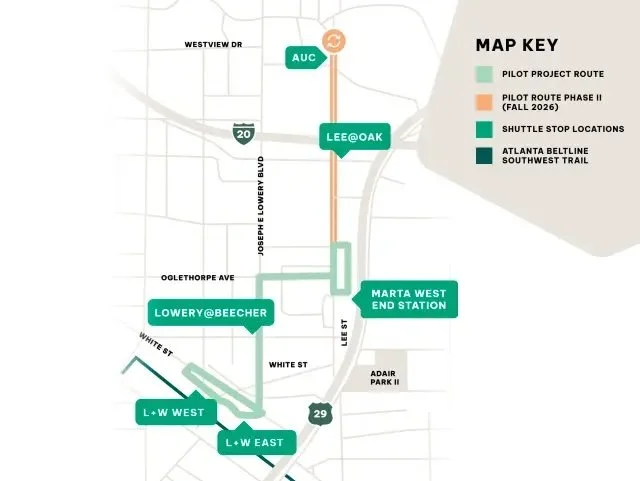
A map of the ATL Spoke route, including the second phase extending to the Atlanta University Center.
The two-mile project was funded by a $1.75 million grant from the Georgia Transportation Efficiency Authority, formerly the Atlanta Transit Link Authority. A second phase is planned for this fall to extend the route northward to the Atlanta University Center.
The use of Turkish technology shows how transit authorities will scour the globe for the best technologies to solve problems like last-mile connectivity, especially in a place like Atlanta, which Atlanta Beltline transit Vice President Joe Iacobucci says will add 100,000 residents per year through 2050. He added that the project will also help gauge “customer perception.”
Karsan first deployed an autonomous bus in real-world conditions in 2021 and has been refining its offerings in preparation to enter the North American market, a push that gains a major boost from the Atlanta deployment.
“The real-world operational experience provided by the autonomous e-JEST, particularly during periods of high passenger demand, will offer valuable insights into future urban transportation solutions,” Karsan CEO Okan Baş said in a news release. Mr. Baş congratulated athe Beltline for its “visionary approach” while thanking Beep and software partner ADASTEC for their collaboration.
Karsan got an order for 10 e-JEST autonomous, electrified buses as it expands into the North American market.
During a Moving Metros forum in May sponsored by the Pendleton Group, former Chamblee Mayor Eric Clarkson micro-transit options will likely grow in favor among city leaders, especially when their connectivity helps underpin lucrative transit-oriented real-estate developments.
“That’s when things really start to work well,” said Mr. Clarkson, who presided over a change in the zoning codes to help drive the growth of apartments and restaurants adjacent the city’s MARTA railway station, installed in the 1980s in a city that originated in 1908 around a rail spur originally known as Roswell Junction.
Likewise, electrification should grow as transit authorities learn to evaluate the costs accurately and see that the technology is ready for prime-time, said Carissa Rowan, a electrification engineer from Heliox, a Siemens company that makes bus charging equipment. MARTA itself operates electric buses provided by New Flyer, a Canadian company.
“It’s a very proven technology, we’re not in the baby phases anymore,” Ms. Rowan said. “We have a lot of really proven success in larger metros like Los Angeles metro or New York or Miami, these really, really large transit agencies that are moving so many people. So we’ve seen it work, and we’ve seen it executed well. So now it’s just a matter of bringing that to everybody else.”