
The Art Exhibit Envisioning 100 Years of Innovation, Technoterria
What will the world look like in 100 years?
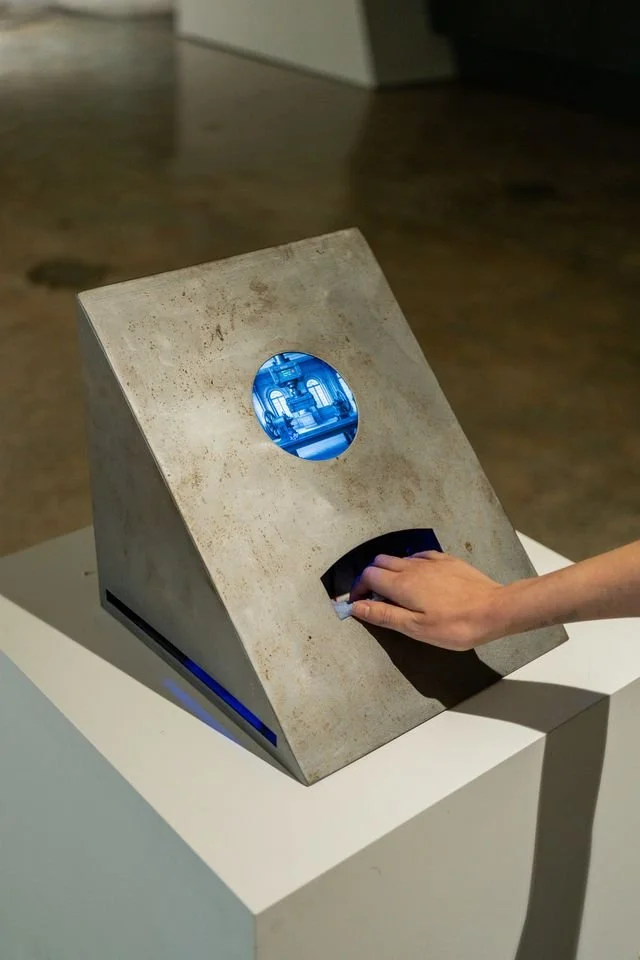
One potential answer to this question is presented across the 40-foot landscape screen in Georgia Tech's Interactive Media Zone (IMZ) in an art exhibition called Technoterria. By interacting with IMZ's tablet screens and custom video game-enhanced sculptures, visitors are immersed in an imagined museum in the year 2125, reflecting on 100 years of technological advancements.
Technoterria is the collaborative creation of Atlanta-based artists T.W. Pilar and Ivan Reyes. The exhibit showcases 100 years' worth of potential technological advancement, placing 2025 as the turning point of industrialization and AI advancement. Within Technoterria, there is a futuristic skyline on the screens and interactive sculptures, accompanied by narration and music custom-created for the exhibition.


The exhibit's perception of the future is a hopeful one. Reyes and Pilar envisioned our future as post-labor and focused on the ways technology has the potential to improve society socially, economically, and environmentally. "There are a lot of questions and concerns around where this technology is going right now, and a lot of what we're seeing is the worst of it, the negative, what could happen, how it affects people. Technoterria is on the optimistic side," said Reyes.
Reyes and Pilar aimed for the exhibit to encourage innovators to create a future similar to the one the artists envisioned, which is exactly why they chose to host Technoterria at Georgia Tech. "A school like Georgia Tech is doing so much for this space, locally in Atlanta. But also, understanding how many future geniuses and future innovators are housed under that same roof was really inspiring to us," said Pilar. Additionally, even prior to creating Technoterria, Reyes was inspired by the IMZ and “fell in love with the space.”
The IMZ opened in the Georgia Tech Library in late fall of 2024. Since then, it has allowed students, faculty, and visitors to experience digital exhibits and project showcases on the large landscape screen and interactive tablets. The space has three content modes, including digital exhibit, pop-up lecture, and hero mode, which promotes campus events, people, and stories. By housing the exhibit in a space with entrepreneurs, researchers, and students, the artists hoped to inspire a future where technology is used for social good.
Technoterria not only showcases a future enhanced by AI development but also used it as a tool in creating the exhibit. According to Reyes, who has a background in both digital art and AI analytics, the artists used accessible programs like Gemini, Midjourney, and Kling AI to create aesthetic consistency and add motion to still images.
The decision to use AI programs that are accessible to everyone was an intentional one. How artists should approach the rise of AI is an ongoing and controversial conversation within creative industries, and Pilar and Reyes aimed for their use of these programs to showcase their vision for where the two fields are going. “These are the capabilities of these programs and how they can overlap with the creative world, which I know is a hot topic for people right now. What do creatives do when this becomes rampant? But this project is an example of what we can do,” said Pilar, whose experience is in sculpture and traditional art.
Although the pair came from different artistic backgrounds, they had been longtime friends within the Atlanta art scene and hoped to collaborate. "I feel like it gave us very specific roles. Both trying to illustrate the same concept from two very different, physical perspectives was a challenge. Still, it seemed necessary," said Pilar when discussing the influence of their different mediums.
According to Reyes, leaving his comfort zone as an artist was a fulfilling experience. "I felt like I was able to make something that was less commercially applicable and more of a commentary on where society is now, where it's going."
The exhibition's stay at Georgia Tech was initially going to end in early August; however, due to the support of the university, students, and faculty, visitors can continue to experience Technoterria in the IMZ for the rest of the year.
Reyes and Pilar still have more stories to tell from the world of Technoterria. "We won't ever be able to share the amount of lore we created for the show… so, we've talked about doing [more] from the universe of Technoterria and offshoot shows down the line, if there's interest, if people want it to travel or use it for education. We'd be able to pull from other parts of that universe," explained Pilar. The pair plan to continue creating interdisciplinary projects that showcase how in their practice, art and technology are not at odds. They see technology as “a third collaborator.”
Although the focus of the project was an optimistic future for technology, the artists wanted Technoterria to display their hopeful vision for the integrity of art as well. “If your personal aesthetic and drive [are] strong enough, all these new programs become tools. It's the next paintbrush. It's not the next challenge. It's not going to eradicate your creativity," said Pilar.