
VasSense Provides Post-Surgical Care for PAD With an At-Home Monitoring Device
Peripheral Artery Disease (PAD) affects around 20 million people in the United States. When untreated — in the best-case scenario — it causes the patient intermittent pain. In the worst cases, the disease results in chronic limb-threatening ischemia, in which the patient experiences pain, numbness, and may even require limb amputation. Even after amputation, 52 to 80% of patients die post-procedure.
PAD is a chronic atherosclerotic disease, meaning there is a continual buildup of plaque in the patient's arteries. This buildup of plaque narrows the arteries, ultimately limiting blood flow, most commonly in the extremities such as the arms and legs.
While there are medications to delay the progression of the buildup, the only way to definitively treat PAD is through surgeries like an atherectomy, in which the surgeon carves the plaque out of the patient’s arteries. However, there is still a 12.5-20% incidence of secondary blockage in patients.
“One of the main problems with [PAD] is post-surgical recovery,” explained Bailey DeCocco, a Founder of CREATE-X startup, VasSense. “There's not really monitoring of the patient's vascular health once they've been discharged and they return home.”
According to DeCocco, there is no consensus on post-surgical surveillance, and the available methods, such as ankle-brachial index and Doppler ultrasound, are expensive and require the patient to return to the hospital.
VasSense is aiming to provide a solution to this post-surgical problem. Their wearable device monitors arterial waveform data to detect a secondary blockage earlier, from home.
Saving Lives and Limbs From Home
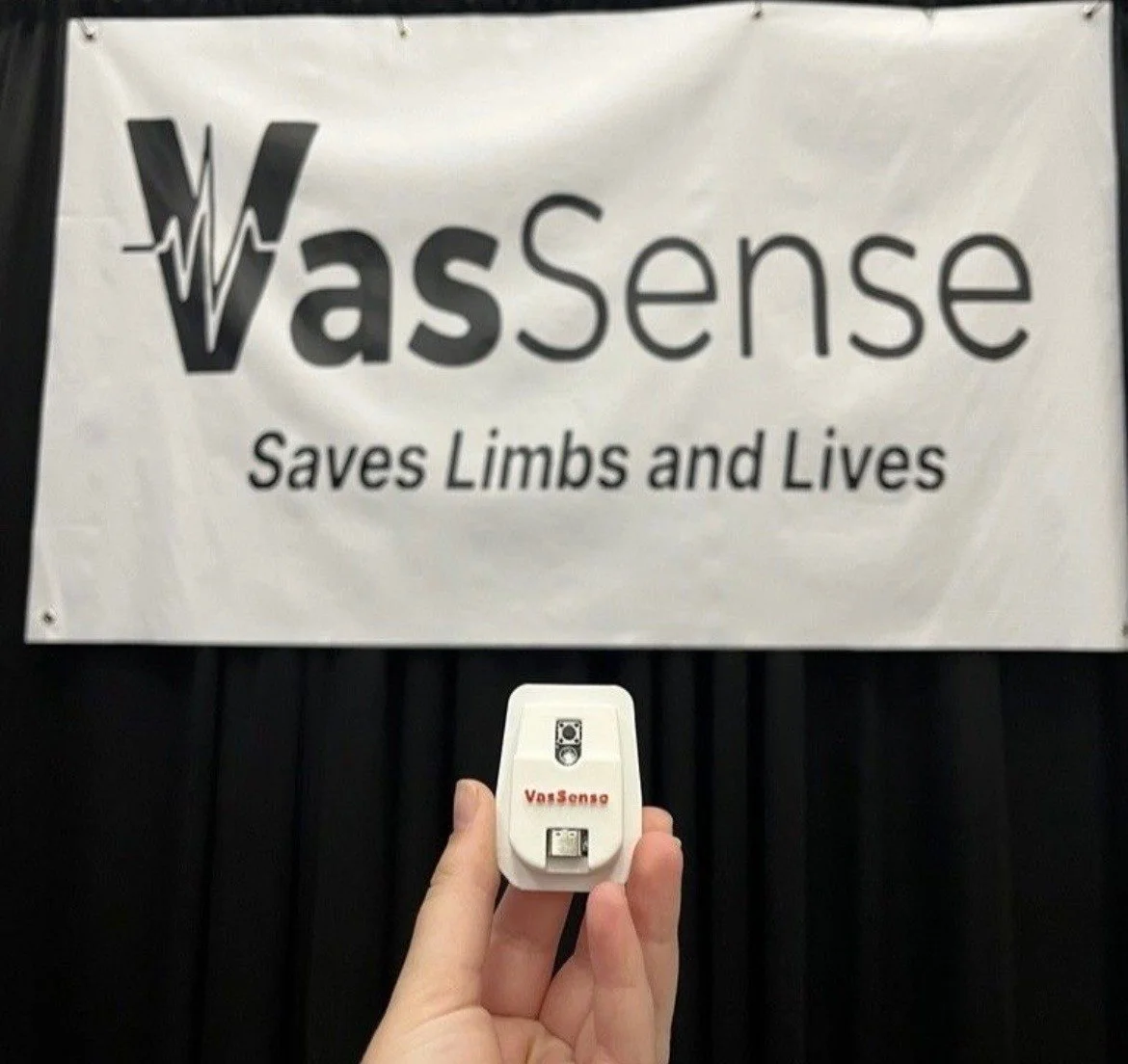
The device is a wearable monitor attached to the patient’s ankle, in the post-tibial artery region. It uses a photoplethysmogram (PPG) system that measures infrared and red light reflected by blood flow, indicating the relaxation and contraction of blood vessels and potentially blocked arteries. From infrared reflections, the system can plot artial waveforms, a visual graph of blood flow over time.
While these waveforms may not be easily readable to the patient, VasSense’s monitor sends the waveform data to the vascular surgeon, who can identify their meaning. There are three types of waveforms, categorized based on how many phases they go through: the Triphasic waveform (three phases of blood flow) is the healthiest, then Biphasic (two phases), and finally, Monophasic (one phase).
It is natural for a person to experience all three types of waveforms; however, a patient who is stuck in the Monophasic period for a long time may be experiencing a secondary blockage. From the monitor's data, the surgeon can identify a potential blockage before it progresses to more severe symptoms.
These waveforms are typically collected by a surgeon in a hospital using a handheld Doppler device, but VasSense connects the patient and surgeon without requiring a clinic visit or incurring additional expenses, making the device unique. The monitor not only enables earlier intervention for secondary blockages but also makes post-surgical care more accessible, allowing patient monitoring entirely from home.
Why At-Home Intervention is Crucial
At-home detection for second incidences and earlier intervention is revolutionary for patients of every kind of chronic disease; however, an at-home monitoring device is especially crucial for the populations most commonly affected by PAD.
PAD is a condition that is exacerbated by other medical conditions, and many PAD patients experience multimorbidity, or the simultaneous existence of two or more chronic health conditions, including diabetes. According to DeCocco, “Many patients with diabetes have neuropathy. The ability to feel when their symptoms are changing due to a secondary blockage is reduced, because they already don't have much feeling in their legs.”
Because patients with neuropathy cannot feel the symptoms of a second blockage, it makes it difficult for them to know when to return to the clinic to prevent the blockage from developing into a more severe case.
Additionally, most PAD patients are 60 or older, meaning the condition has a primarily senior population. “A lot of older patients maybe don't drive anymore or don't have the resources to get themselves to any sort of medical center,” said DeCocco. An at-home monitoring device would make the post-surgical care that the senior population needs more accessible.
Furthermore, VasSense aims to give support to medically underserved areas, including rural minority populations. According to the Society for Cardiovascular Angiography & Interventions, rural minority populations, especially in Southern and Western states, “often face some of the lowest levels of access to care for PAD.” This disparity between care for minority and non-minority groups is especially problematic because African Americans have an increased risk of PAD. According to the American Heart Association, nearly 1 in 3 Black adults are at risk of developing PAD, compared to 1 in 5 white and Hispanic adults; however, they are also less likely to receive a timely intervention and more likely to have to undergo amputation.
Currently, due to expenses, travel, and medical inequity, post-surgical care for PAD is inaccessible to the populations who need it most. An at-home monitor like VasSense would make care more affordable and accessible, allowing for the detection of preventable second blockages before they progress to more severe stages.
Created in Capstone, Ready for the Real World
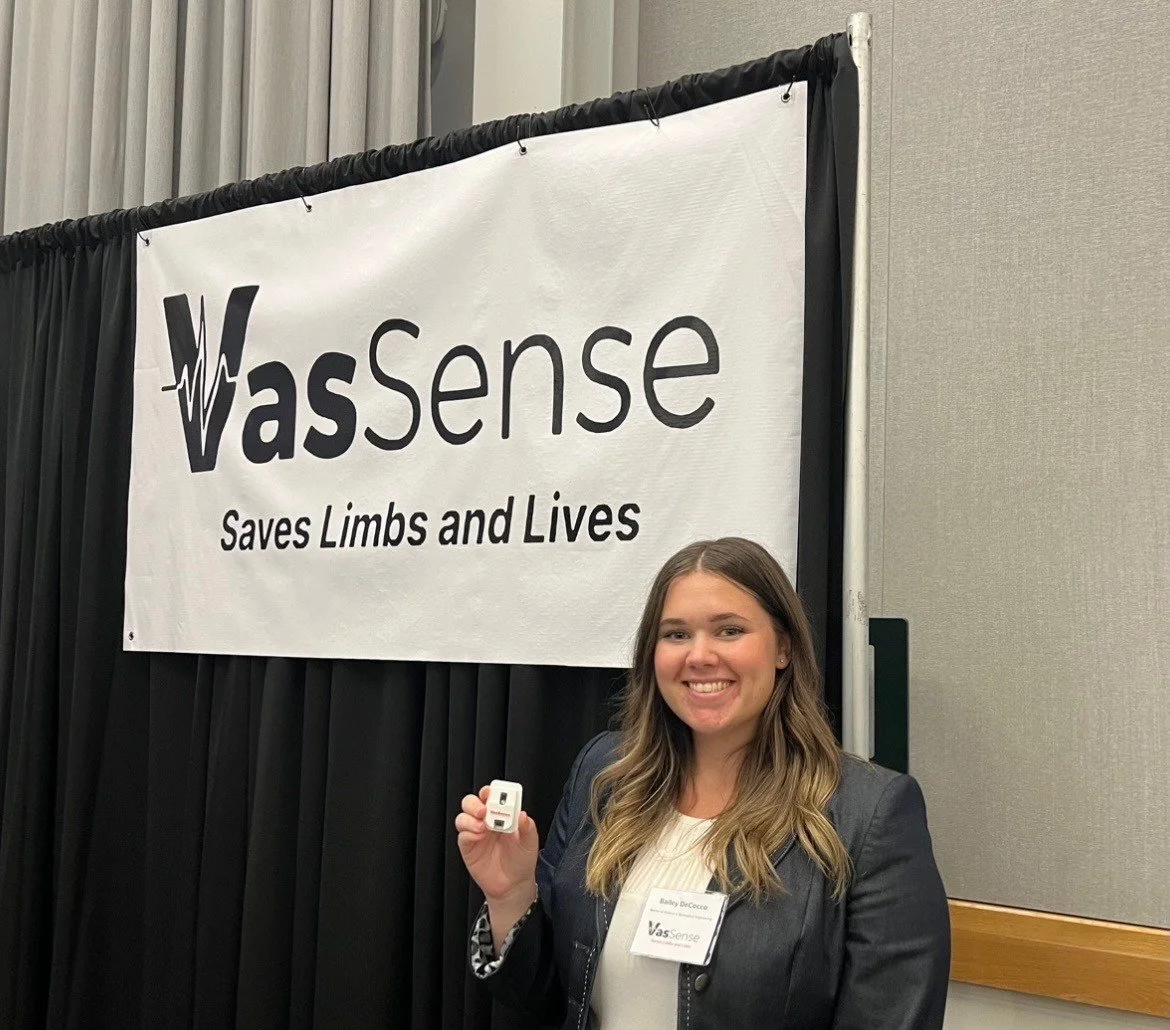

The idea behind VasSense originated from DeCocco’s advanced capstone class through Georgia Tech’s Department of Biomedical Engineering.
In the capstone course, she and a group of master’s students, including co-founders Sujit Tunuguntla, Diva Yadav, and Marika Misabishvili learned from their co-inventor, medical student Ram Akella, about the problems they had noticed in the operating room. From there, they did customer discovery with various surgeons, and the idea evolved into VasSense’s current mission.
Although she had been drawn to medical device development, before the capstone, DeCocco never pictured herself as a start-up founder. However, her experience in advanced capstone inspired her and Tunuguntla to take VasSense from the classroom into the start-up world.
“I had always thought I needed to be working with an already established company in order to do this. But as I was going through the advanced capstone course, we were discussing how you can actually establish this product in the market… and also, we had discussed doing CREATE-X. So, the switch flipped,” explained DeCocco.
The road to creating the device has not been without challenges. Over the summer, DeCocco taught herself how to use a printed circuit board schematic for the device. “Regulatory is going to be our biggest hurdle coming up. And even as we've been developing, that's always been something on the back of our mind, like, OK, can we actually do this?” said DeCocco.
However, they have not had to brace the challenges alone. They found support from Georgia Tech and the greater Atlanta innovation community. “If you don't know how to do it, someone in your direct circle definitely knows how to do it,” said DeCocco.
Now, DeCocco and Tunuguntla are approaching the next steps for VasSense with open minds. “We're very open to where it can go, and we are willing to see if it's possible.”