A Lens on Food Waste: How Raccoon Eyes Tackles the Problem with Vision AI
Pairing a lifelong interest in cooking, especially the gathering with friends and family around the table, with financial responsibility is what inspired Ivan Zou, the co-founder of Raccoon Eyes, to dig into the problem of food waste.
Ivan shares, “When I started seeing how much food was being not eaten by students and wasted in kitchens, I was inspired to find a solution at the intersection of the kitchen and consumer that could help avoid both waste and economic cost.”
Raccoon Eyes does just this by monitoring our trash cans and our future, addressing the 22 million pounds of food wasted annually in U.S. universities, which is approximately 142 pounds for the average college student, by delivering measurable reductions in campus dining waste.
“When I started seeing how much food was being not eaten by students and wasted in kitchens, I was inspired to find a solution at the intersection of the kitchen and consumer that could help avoid both waste and economic cost.”
Recognizing Food Waste in Under a Second Using Vision AI, 3D Imaging, and AI/ML
Photo by Raccoon Eyes
Powered by vision AI to understand the type of food waste and 3D imaging to measure its weight, Raccoon Eyes calculates the food waste with 90% accuracy. All of this happens in less than a second, by showing pans, trays, and serving containers to scanners before food is thrown out by kitchen staff, or as students place thousands of plates a day on the conveyor belt, where they will pass under the camera, as they return to the kitchen for disposal and cleaning.
To achieve this, Raccoon Eyes maintains an updated dataset containing thousands of labeled pictures of food waste to support automated identification with the artificial intelligence/machine learning (AI/ML) model. This real-time, AI-driven process replaces the manual weighing of food waste, which is a time-consuming task. For example, kitchen staff must manually move and weigh the trays, which puts a lot of pressure on them, especially towards the end of the day/work shift. Additionally, there are space or logistical constraints to consider, such as where to place a scale in the kitchen to track food waste.
Co-founders Ivan Zou and Bowen Tan, Georgia Institute of Technology Computer Engineering and Computer Science graduates, respectively, initially blended interests in reducing food waste, AI, and ML to launch Raccoon Eyes as part of their CREATE-X Capstone, resulting in winning the Fall 2022 Senior Capstone Expo. The team has also been a finalist for the 2023 Georgia Tech InVenture Prize and won second place at the 2023 Sustainable-X Showcase.
Serving up Customized and Actionable Insights
The results of Raccoon Eyes 3D imaging and AI/ML-driven food waste calculations provide cafeteria-specific, data-driven insights that can help kitchens optimize their menus or serving methods based on the food that is being wasted or not served at all. For example, Ivan shared that “in a new deployment at a U.S. university, for a chicken wrap that was being served, the data revealed that 70% were eating the chicken and not the wrap/bread”.
Revealing this highly customized insight from the analyzed data is how Raccoon Eyes works together with kitchens and teams to learn about their food waste and identify a few of the most impactful and feasible solutions each semester to optimize meals for students. In another case, Raccoon Eyes was able to track leftover ribs and rib bones to help a kitchen fine-tune their production and timing, leading to better quality ribs, management of labor, and reducing overproduction waste.
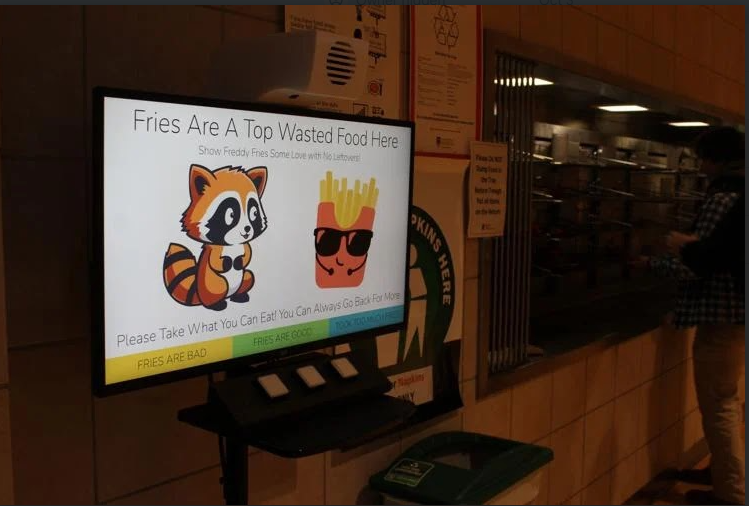
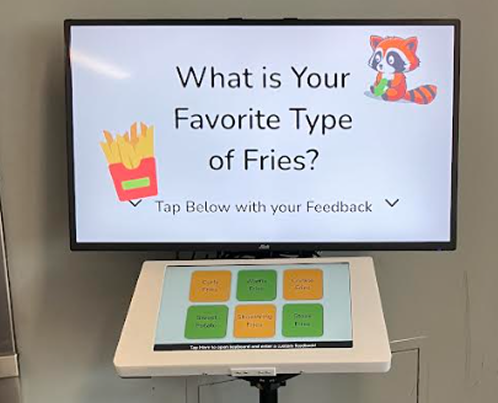
For example, measurable success has been reported at Georgia State University, following the AI-powered Raccoon Eyes installation. “In just eight months since launching in September 2024, food waste at the Central Dining Hall and North Dining Hall declined by 43% and 16%, respectively,” shared Dr. Nesreen El-Rayes, Clinical Assistant Professor in the Department of Management in the J. Mack Robinson College of Business at Georgia State University.
Dr. El-Rayes adds, “it’s just as important to add that students’ post-meal satisfaction feedback increased by 10% and 5.6%, respectively for the two dining halls, indicating that this sustainability improvement did not compromise the dining experience.” Paired with the implementation of Raccoon Eyes, the Georgia State University Sustainability Initiatives Office hosted a student orientation in November 2024 to raise awareness about food waste and promote responsible dining habits, such as starting with smaller servings and refilling plates as needed, to minimize leftovers.
“In just eight months since launching in September 2024, food waste at the Central Dining Hall and North Dining Hall declined by 43% and 16%, respectively. It’s just as important to add that students’ post-meal satisfaction feedback increased by 10% and 5.6%, respectively for the two dining halls, indicating that this sustainability improvement did not compromise the dining experience.”
From the Commons to the Classroom: Connecting Students with Real-World Data
Ivan Zou with National Student Data Corps Club members at Georgia State University. Photo by National Data Corps Club.
In addition to reducing food waste, Georgia State University has integrated real-world data from Raccoon Eyes to provide both graduate-level project opportunities and hands-on experience for undergraduate business analytics students.
Under the supervision of Dr. Wendy Roth and Dr. Nesreen El-Rayes at the J. Mack Robinson College of Business in the Department of Management, nine MBA students analyzed the datasets collected through the Raccoon Eyes AI system to generate actionable insights aimed at helping Georgia State University Dining reduce food waste and improve operational efficiency. The project’s findings led to the development of two research posters, which will be presented at the INFORMS Annual Meeting 2025 in Atlanta. These posters highlight both the scale of campus food waste and the transformative potential of AI-powered image recognition in addressing sustainability challenges.
In parallel, the National Student Data Corps at GSU, an undergraduate club, also housed within the Management Department, has been granted access to one year of dining hall data. This initiative enables undergraduate business analytics students to gain hands-on experience with real sustainability data while raising awareness about food waste and promoting data-driven impact across the campus community.
“Not only the culture of working with kitchens, but also the potential with business, to be more efficient and save money. This includes labor, transportation, purchasing, time spent, and staffing in kitchens.”
A Recipe for Change: Engaging the Next Generation
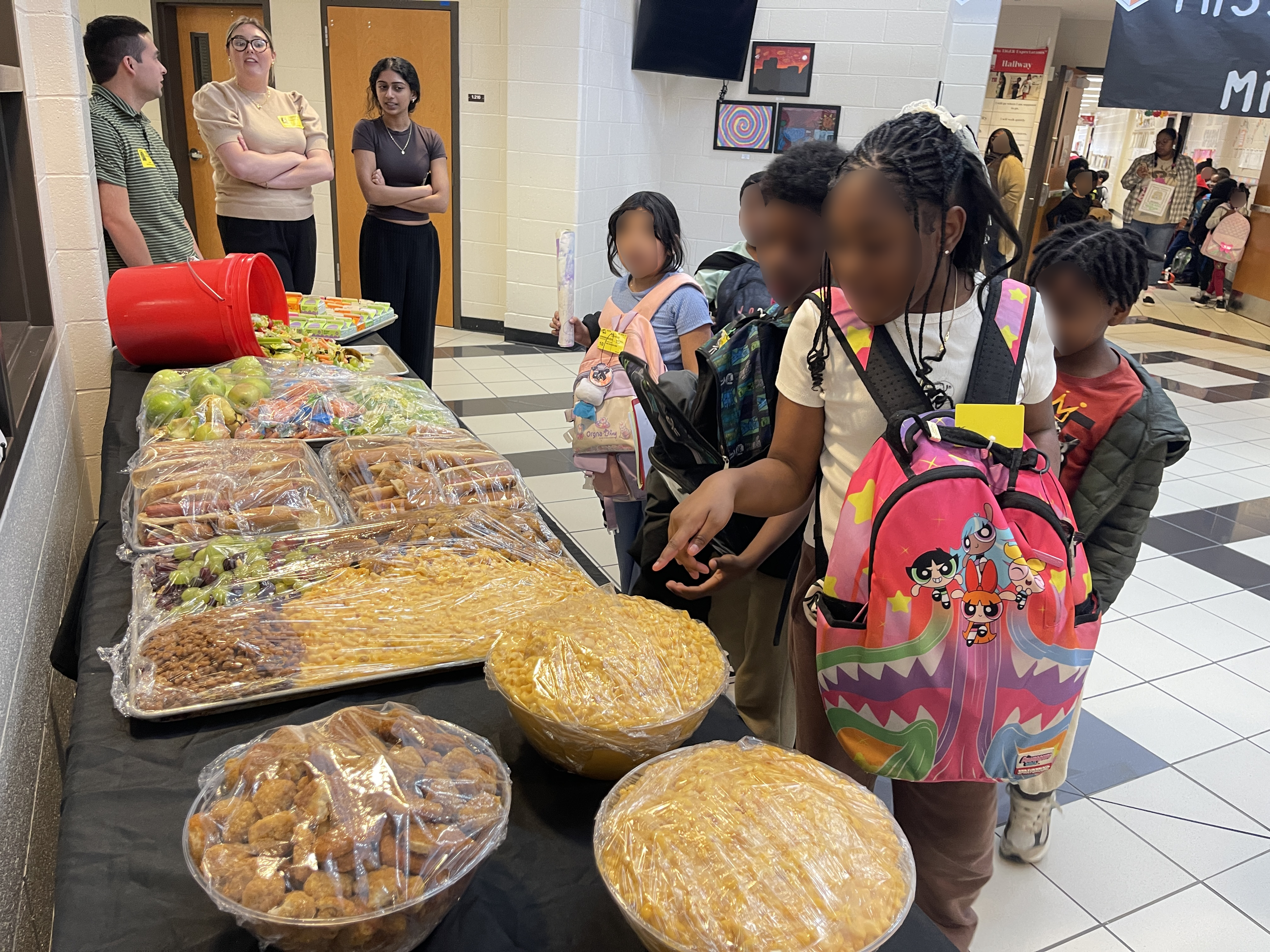
Photos by Raccoon Eyes and Scheller College of Business Sustainability Fellows and Undergraduate Sustainability Ambassadors Project Team
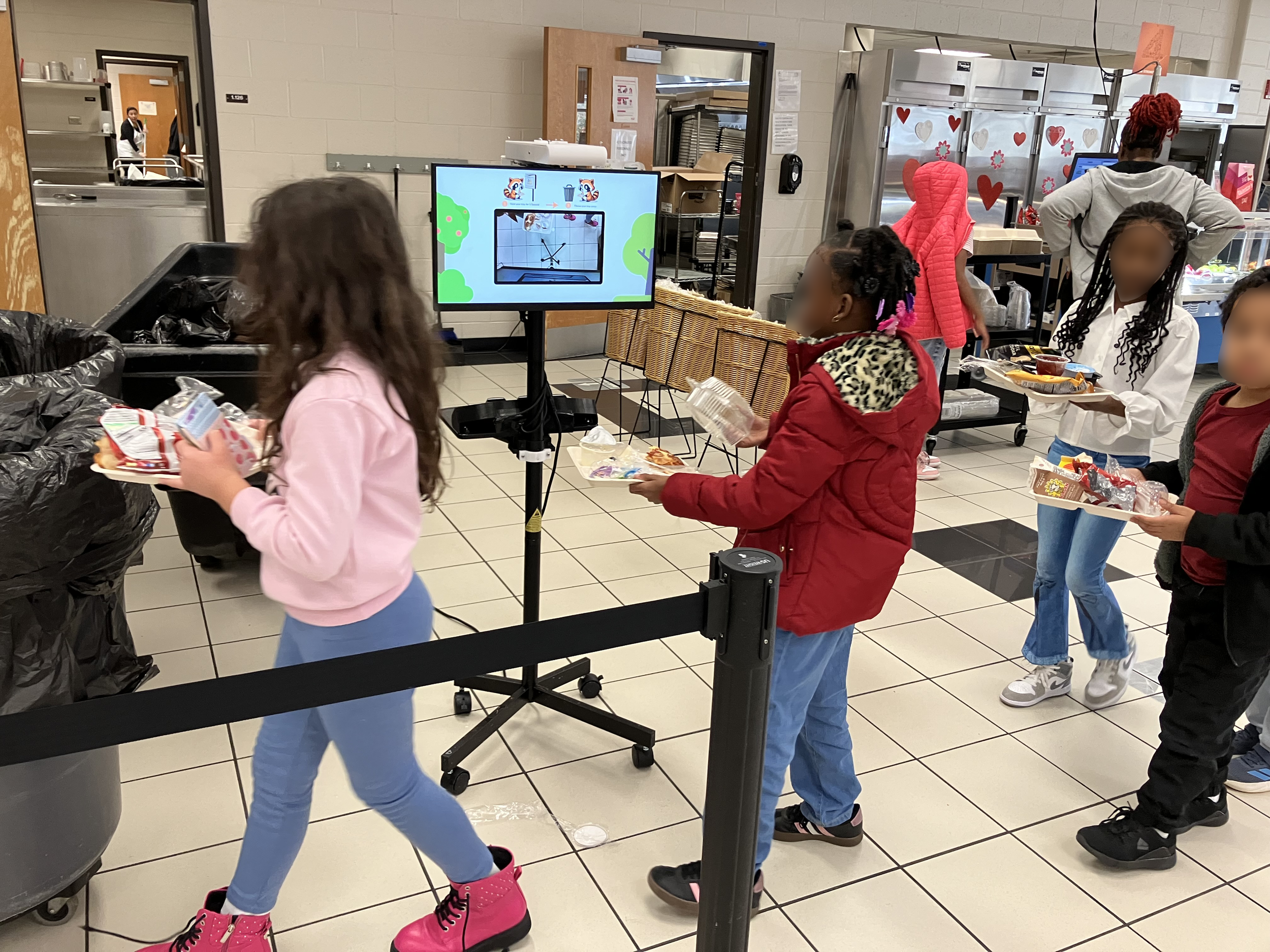
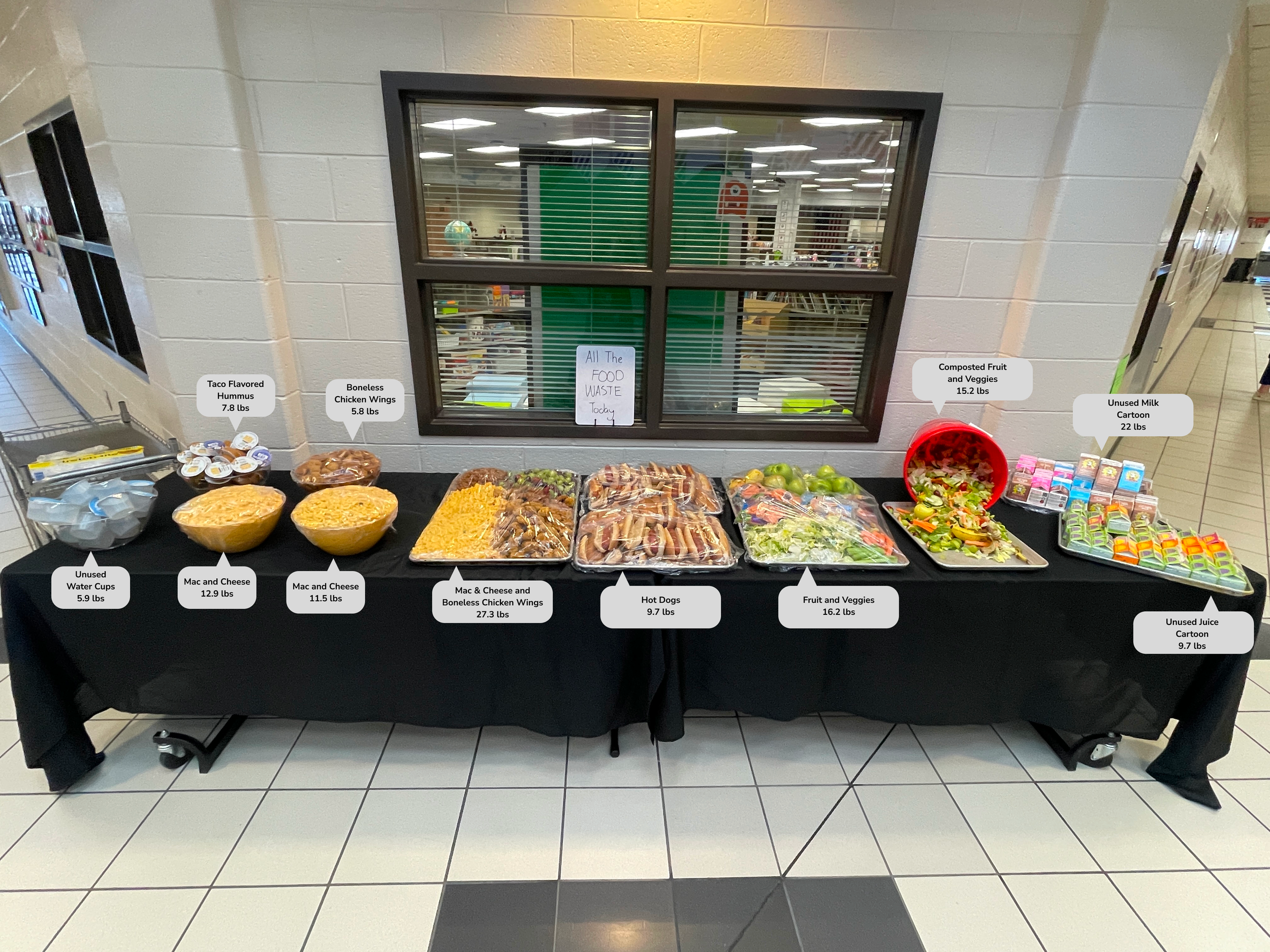
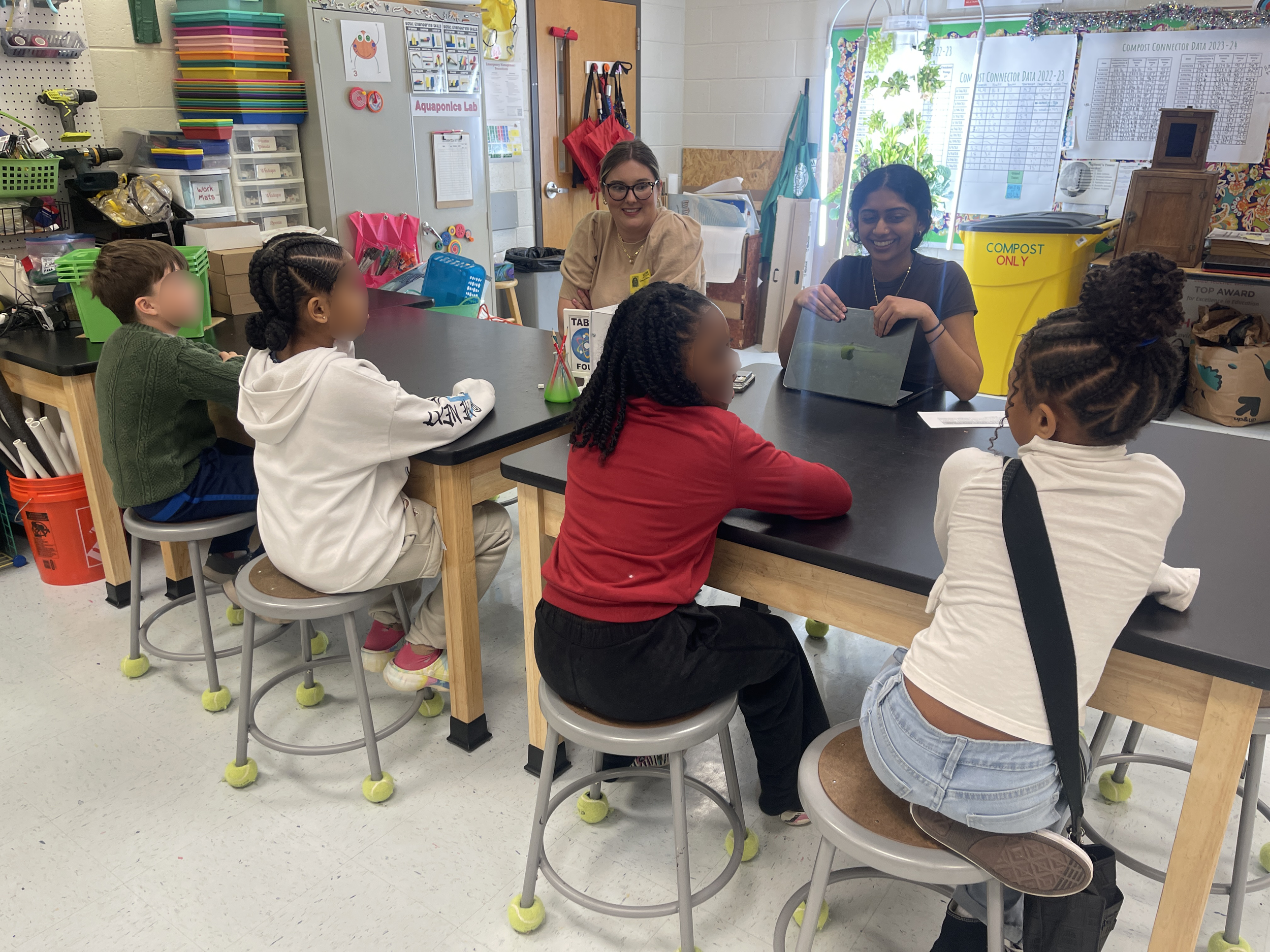
To explore the intersection of operational excellence, behavioral change, and sustainability, Georgia Tech students Catherine Dent, Nikhita Chinmay, and Ivan Santillan collaborated on "Waste Not, Watch Lots: Raccoon Eyes AI on Food Waste" as part of the 2024-2025 Sustainability Fellows and Undergraduate Sustainability Ambassadors Project. In collaboration with the Ray C. Anderson Center for Sustainable Business in the Scheller College of Business, the team installed Raccoon Eyes technology alongside efforts to encourage actionable behavioral change in an Atlanta elementary school, aiming to address food waste. They found that food waste accounted for 144 pounds during just one lunch period.
Using the data-driven results from Raccoon Eyes, onsite visits, waste categorization, and feedback-driven interviews with students, the team made specific recommendations for smarter portion sizes and menu adjustments. The behavioral change focus was on launching a Raccoon Eye Kiosk, featuring the mascot “Rowdy the Raccoon,” which has engaging narratives tailored to different grade levels to draw attention to the impacts of food waste and enhance student participation with real-time audio and visuals. The team also crafted engaging educational materials, such as posters and stickers, containing positive nudges to encourage students to make better food choices, such as when taking food, composting, or sharing unopened snacks.
Ivan shares, “In elementary schools, the focus is on engagement, education, and behavior change with these students so they can learn at a young age how not to take too much food.” Rowdy is currently scavenging for food waste at seven universities, located in Georgia, Michigan, Florida, and Texas, as well as elementary school cafeterias in Georgia.
Focusing on Long-Term Value and a Future with Less Food Waste
Photo by Jas Min on Unsplash
Each year, 120 billion pounds of food are wasted in the United States, which is 325 pounds of waste per person. This is estimated to be approximately 40% of the entire US food supply, resulting in a loss of around $160 billion per year. And at the same time, nearly 14% of U.S. households did not have enough food on their tables in 2023, according to the United States Department of Agriculture's national annual report on household food security.
In addition to the economic cost of paying for food that is not eaten, there are costs associated with transporting the waste to landfills, as well as the ongoing management and monitoring of these facilities. On the environmental side, food ends up in landfills, where it produces methane, a potent greenhouse gas. Reducing food waste is one of the 20 Drawdown Georgia Climate Solutions presented to reduce carbon emissions.
Drawdown Georgia, which is a multi-university research-based initiative launched in 2020 with funding from the Ray C. Anderson Foundation and led by Georgia Tech in collaboration with researchers at Emory University, Georgia State University, and the University of Georgia, highlights several major projects that aim to prevent, recovery, and recycle food such as the Atlanta-based startup Goodr, which Jasmine Crowe-Houston launched in 2017 to “Feed more and waste less” by picking up food waste and redistributing it for the greater good.
Other solutions exist to prevent food waste from entering landfills and reduce methane emissions, such as the food waste pick-up service CompostNow, which is also available at Georgia Tech's dining halls. Another Atlanta-based organization is Concrete Jungle, led by Executive Director Katherine Kennedy, which celebrates foraging, farming, and redistributing Georgia-grown produce that would have otherwise gone to waste with hunger relief organizations across the state.
Ivan highlights that it is “Not only the culture of working with kitchens, but also the potential with business, to be more efficient and save money. This includes labor, transportation, purchasing, time spent, and staffing in kitchens.”
Photo by CDC on Unsplash