Initially inspired by female protagonists of the 70s, such as Wonder Woman, Dr. Heidi Boisvert has dedicated her career to exploring how mass media, emerging technology, and neuroscience can ignite social change.
Boisvert, who joined Georgia Tech in August 2026 as the inaugural chair of the newly launched School of Arts, Entertainment and Creative Technologies, shared in a recent lecture in Tech Square that while her childhood heroes exhibited agency, they also promoted dominant and harmful worldviews of the time in the United States.
Before joining Georgia Tech, Boisvert founded a boutique creative agency that designs digital projects with mass appeal for nonprofits called futurePerfect lab, co-founded XTH Sense, an open-source creative bio-wearable start-up, and is currently working with David Byrne on Theater of the Mind, an immersive theater piece.
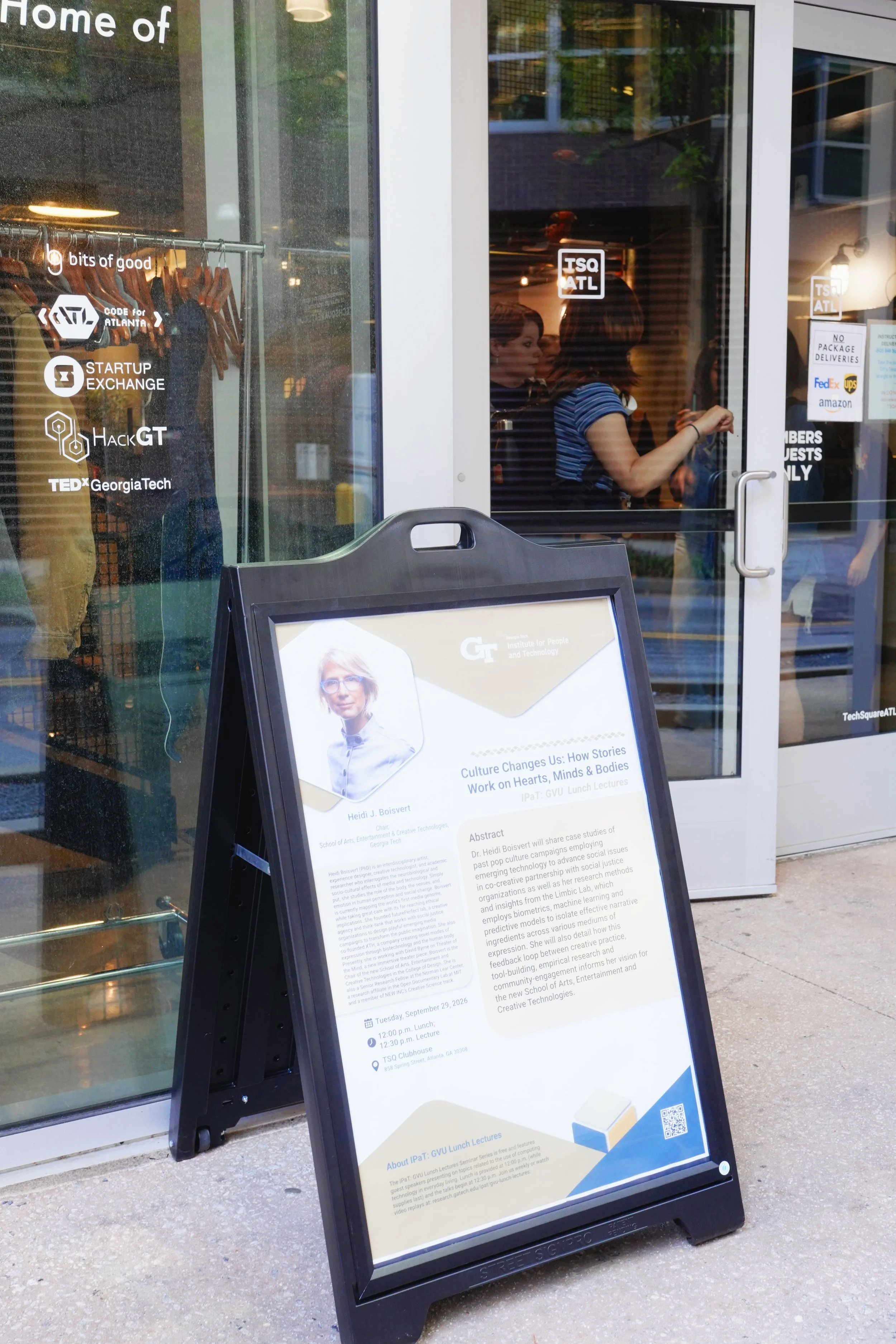
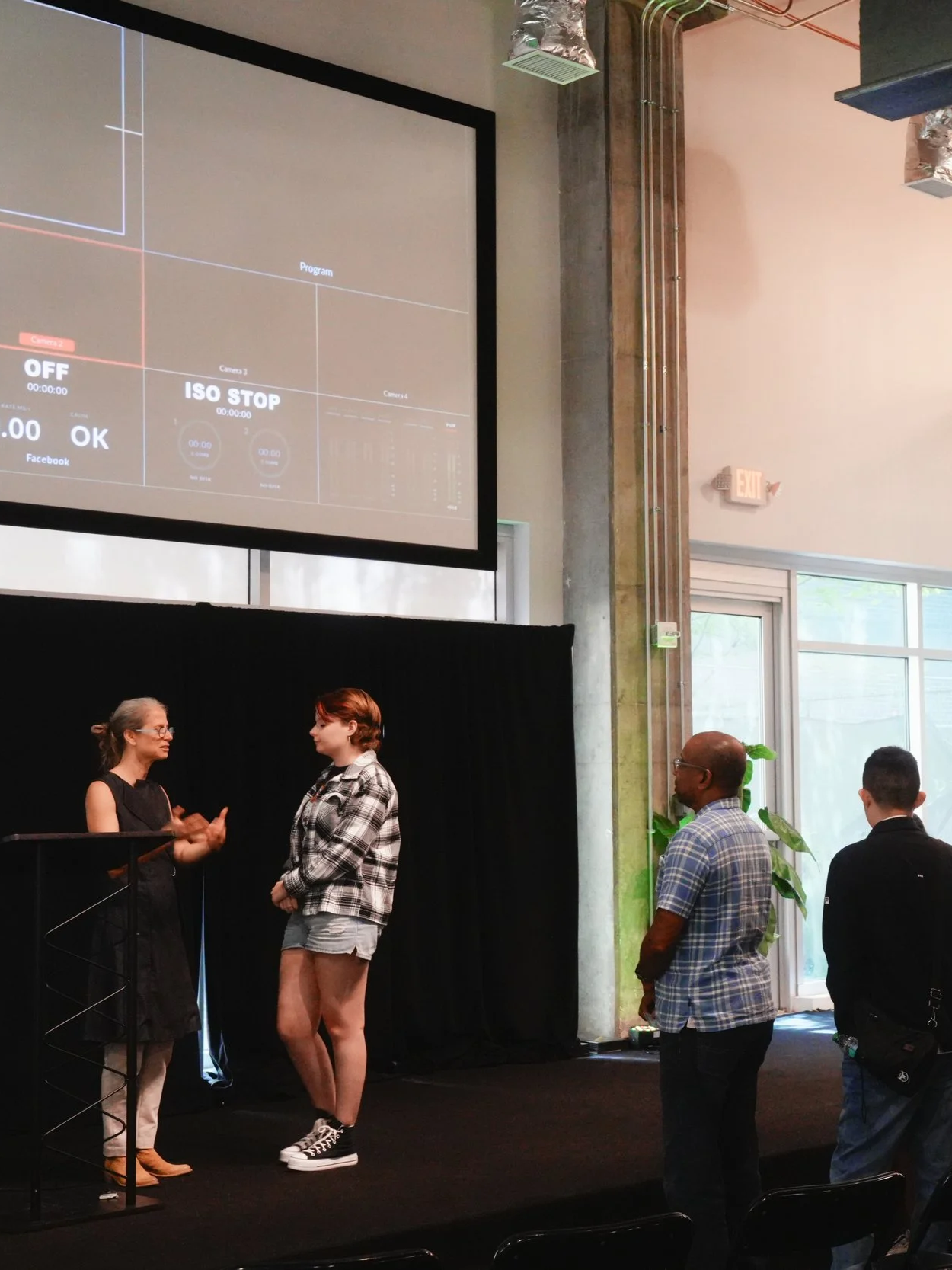
In her Institute for People and Technology (IPaT): GVU Lunch Lecture, on September 29, 2026, Culture Changes Us: How Stories Work on Hearts, Minds & Bodies, held in the Tech Square Clubhouse, Boisvert shared case studies from her creative practice and empirical work along with plans for the new school, which is in the College of Design at Georgia Tech.
As an interdisciplinary artist, experience designer, creative technologist, and academic researcher, Boisvert shared with lecture attendees that she seeks to “transform our narrative galaxy” into a “more just and pluralistic society where everybody doesn’t only belong, but can thrive.”
To do this, Boisvert shared that her focus is on transforming the public’s imagination of what could be and advancing social change through playful, emerging-media campaigns driven by creative, artistic, and innovative uses of emerging technology.
How Culture Changes Us, and What We Can Do About it
In her IPaT: GVU Lunch Lecture, Boisvert noted that, over time, society was moving away from the mass culture of the 70s toward a culture of anonymity, in which people appear to operate in different cultural ecosystems.
To challenge this fragmentation of belonging, Boisvert highlighted an example from her earlier work, America 2049 (Breakthrough). In this alternate-reality Facebook game, players can explore a near-future America where human rights and democracy are crumbling. Boisvert shared that the experience promotes an investigation into how we can work together, including offline, to build a more just future.
But even when working on projects like America 2049, Boisvert still had questions about the relationship between mass media and its impact on society and our experience as humans.
“After making this work for many years, I had a crisis of faith. Were the tools that I was using to change hearts and minds actually harmful? I was concerned that humans were like APIs running on scripts or protocols,” said Boisvert in the lecture.
As a result, Boisvert pursued and obtained a PhD in Electronic Arts from Rensselaer Polytechnic Institute to study the socio-cultural and neurobiological impacts of media. Boisvert’s research focused on how our neurological processing is impacted by the media that surround us each day, which Boisvert described to attendees can impact our emotion-feeling center and fight-or-flight responses.
You Are Here: Now What?
Boisvert shared with the IPaT lecture attendees her research on how we got to where we are today, based on critical inflection points in technological trends and advancements. She pointed specifically to the legacy of cybernetics, which Boisvert described as promoting a “rejection of the body, regulation of emotions, and canalization of the senses,” moving our consumption of mass media from external to internal colonization.
Boisvert’s PhD and ongoing work also explore potential antidotes to restore critical feeling and counter the neurobiological impacts of media: aesthetics, the arts, creative technologies, and embodiment.
Boisvert shared a quote from Caroline Jones that inspires her work. Jones said, “The only way to produce a techno-culture of debate at the speed of technological innovation itself is to take up these technologies in the service of aesthetics.”
As a result, Boisvert seeks to use wearable devices not only as a functional data-driven device but as a bio-adaptive creative technology, which is one that can act as an expressive instrument responding to a user's heart rate, for example, and adapt the experience of the media.
Movement, Embodiment, and Healing
So how can social justice messages be created for mass appeal?
One theme of Boisvert’s work is to encourage embodiment, especially in our increasingly online culture.
“I returned to dance as an antidote. Bring people into physical, intimate, immersive spaces,” said Boisvert to lecture attendees.
An example shared at the lecture was an interactive dance project called [radical] signs of life. In this multimedia experience, the dancers' moving muscles and blood flow generate music using a custom-built biophysical sensor. In this networked dance performance, audience members can also interact with projected 3D images from the dancers, entering into an interactive dialogue. Boisvert shared that conceptually the piece explores bio-memory and biodata.
Boisvert described to lecture attendees how exploring dance, immersive theatre, and installations led her to realize that the root of what she was doing was related to the epigenetic trauma that is held in the body.
For example, Boisvert described in the lecture how she expanded and moved her work to transform trauma in the dancers’ bodies, working on projects such as Walking Wounded, a multimedia performance, using custom instruments to generate music and imagery from the dancers’ nervous systems. In the lecture, Boisvert shared that she has run workshops with combat vets, individuals who have experienced domestic violence, and newly arrived refugees.
Building upon her previous work focused on embodiment and trauma, during COVID, Boisvert shared that she worked on Run+Skip+Play: An Augmented Reality Chalk Game, which engaged 100 people in Los Angeles, California, to use their bodies in public spaces and co-create art. For this piece, Boisvert shared with lecture attendees that she created an OSC bridge that combined spatialized sound data from participants’ phones. The goal of this piece was simple. To get people outside, into their bodies, and to play in a public space.
To date, Boisvert shared that the work she has contributed to has increased awareness of “hot-button issues”, such as how media fragments our shared reality and the fragility of democracy, in 166 countries, garnered 25 million views, and achieved an 84% attitudinal change. “None of this work is possible without using this emerging technology to meet people where they are at,” said Boisvert.
Boisvert's Vision for the Newly Launched School and First Cohort of Students
Since joining Georgia Tech in August and grounded in the feedback loop between creative practice, tool-building, empirical research, and community-engagement, Boisvert is applying her experience, creativity, and strategic insight as the inaugural chair of the School of Arts, Entertainment and Creative Technologies, which Boisvert shared has enrolled 47 Bachelor of Science in Arts, Entertainment, and Creative Technologies students in its first cohort.
When speaking about her approach to IPaT GVU Lunch Lecture attendees, Boisvert said, “I’ve been doing a lot of listening in my first six weeks. I want to be a good neighbor, be collaborative, and bring things together.”
Related to designing the student experience for the new major in the new school, Boisvert highlighted the focus areas of teaching systems, not tools, and creating the conditions for students to be the makers of creative technology, not just using commercially available technology.
Additional focus areas for the new school that Boisvert mentioned include enabling students to understand the social and neurobiological impacts of the technology they are making on society and cultivating relationships with nonprofits and communities in Atlanta so students and community members can engage with each other and co-create and have an impact on the world.
At the close of the lecture, Boisvert asked attendees, “How will we work together to transform our harmful galaxy to create more just mass messages?”