
Modernizing Intelligence in a Data-Saturated World
When Martin So was training as a military intelligence analyst, the disconnect was hard to ignore
“The things that I was taught were very archaic, very outdated,” he says. Even as global threats evolved across cyber and digital domains, much of the work still relied on manual processes. Analysts spent hours compiling reports, moving data between systems, and trying to assemble a coherent picture from scattered information.
That realization followed him through his deployment in Eastern Europe and ultimately shaped the foundation of Panoptica Technologies.
Today, alongside cofounder Vishal Puppala, So is building a platform designed to automate and accelerate intelligence analysis using artificial intelligence.
Two Paths, One Problem Space

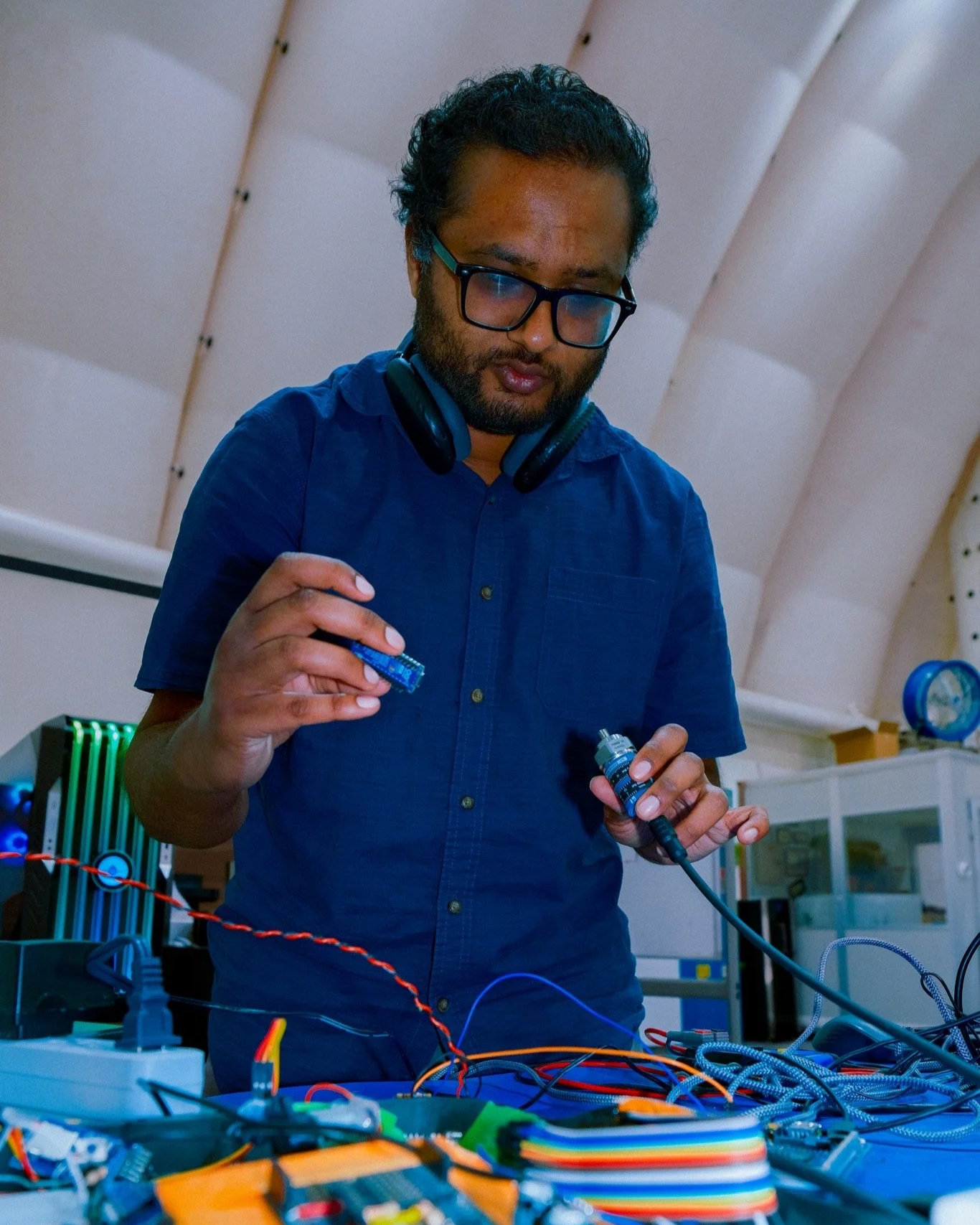
So and Puppala met through Georgia Tech’s Master of Science in Analytics program, where a shared interest in large-scale systems brought them together.
Their motivations, however, came from very different places.
So’s perspective was shaped by operational reality. “In 2026, adversaries are swarming the battlespace with large amounts of indicators and warnings, false narratives, and deception in the milliseconds. There’s so much data to collect and very little time to analyze,” he says. “By the time the intelligence analyst is able to build a picture, the enemy has gone 10 steps. ahead already In the heat of the moment, military commanders are put in positions where they are forced to make critical decisions with incomplete information, leading to a lot of lives being lost.”
Puppala’s path was more philosophical. “From a really young age, I was obsessed with this idea of immortality and living forever,” he says. That thinking eventually shifted toward impact. Inspired by stories like The Epic of Gilgamesh, he began to focus less on permanence and more on building something that could leave a legacy that impacts future generations.
That shift pulled him away from academia. While working in a neuroscience lab, he found himself questioning the practical value of what he was studying. “What’s the application of this?” he recalls asking. At the same time, he was learning to program and exploring the startup world. “I realized startups offered a path to tackle problems at scale in ways that traditional institutions often could not,” he says.
Panoptica sits at the intersection of those two perspectives. One grounded in real-world urgency. The other is systems thinking and long-term impact.
Automating the Intelligence Cycle
At its core, Panoptica is built around a simple premise. Modern intelligence problems overwhelm manual analysis.
So saw that imbalance firsthand. “A lot of what we were doing was manual and time-consuming,” he says. “I wanted to explore a simple idea: is there a way to automate this cycle?”
Panoptica’s answer is Watchtower, a platform that uses AI and machine learning to streamline the intelligence process.
The system continuously monitors data, identifies signals, and surfaces patterns in real time. It can process large volumes of open-source information, flag indicators of emerging threats, and translate fragmented or coded communication into usable insights. But what Panoptica brings to the edge is the ability to generate enemy courses of action, which can predict the enemies’ next moves in the next 24-48 hours so that military commanders can make pre-emptive countermeasures to neutralize threats.
But the goal is not to replace analysts.
Instead, the platform is built around a human-in-the-loop model, keeping analysts focused on interpretation and decision-making rather than collection.
The result is a system designed to reduce cognitive load and speed up analysis in environments where timing matters.
Building with Access and Context
Panoptica’s approach to data goes beyond automation.
The team integrates insights from domain experts and on-the-ground sources, adding context that automated systems often miss. “They’re essentially a second layer of human judgment,” Puppala says, describing how subject matter expertise helps interpret and validate incoming data.
That combination of technical infrastructure and real-world input is central to how the company operates, particularly in regions where reliable information can be difficult to access.
Panoptica is currently focusing on asymmetric and irregular threats in Latin America that may threaten American interests, building models tailored to the region’s specific dynamics.
Why a Startup?
For both founders, the decision to build Panoptica as a company rather than within an existing institution was intentional.
“Companies are better at solving these problems,” Puppala says. “Governments have so much red tape, so much bureaucracy.”
So frames it in more structural terms. He describes Panoptica’s internal model as a “special forces mindset,” where small, highly specialized teams operate with speed and precision. “Your technical teams are specialists,” he says. “Your management team is generalists, like officers in the military.”
That structure allows the company to move quickly in a space where traditional organizations often cannot.
From CREATE-X to Early Traction
Panoptica began taking shape in early 2025, following months of ideation and experimentation.
The team later joined Georgia Tech’s CREATE-X startup incubator, where the structure helped refine their approach.
“Being part of a structured program kept us accountable,” the founders say. “CREATE-X really hammered on customer discovery.”
The program also provided a network of founders and mentors to pressure-test ideas and iterate quickly.
Since then, Panoptica has gained early traction, raised initial funding, and engaged with defense and security stakeholders. The company has also been accepted into competitive programs and pitch competitions, including the Rice Business Plan Competition.
Reducing Uncertainty
At a high level, Panoptica is focused on one core problem: uncertainty.
For So, that problem is immediate and operational. “If you don’t know the full picture, you’re putting lives at risk,” he says.
For Puppala, it connects to broader ambition. Building systems that improve how people understand complex environments is, in his view, a way to create lasting impact.
The company reflects both perspectives. It is both a technical platform and a response to a growing imbalance between the volume of information available and the ability to act on it.