
Listening to Georgia's Data Centers
When Sylvia Janicki set out to record the noise of Atlanta's data centers, she expected to find it everywhere. News stories described nearby communities living with constant humming, roaring generators and sleepless nights. So she drove to roughly 10 hyperscale facilities around metro Atlanta, the massive campuses built to power artificial intelligence and hit record.
What she found was quieter and stranger than the headlines suggested.
"The noise wasn't super prominent for someone that just drove in and was looking for it," Janicki said. "That became an interesting point to unpack."
That puzzle sits at the center of Rest Against the Machine, an installation and research project by Janicki that was displayed earlier this summer, a postdoctoral researcher in Georgia Tech's School of Interactive Computing. Working with professors Shaowen Bardzell (ESCape Lab) and Josiah Hester (Ka Moamoa Lab), Janicki studies the environmental footprint of AI infrastructure, and the project marks her first ethnographic dive into the physical world behind the cloud.
She picked a timely subject. Metro Atlanta has become the second-largest data center market in the country and facilities lease up almost as fast as crews can build them. That growth has pushed noise, along with power and water demands, into public meetings and legislative debates across Georgia.
From Data to Sound
The project grew out of an earlier collaboration. Janicki showed work in Queer Data Ecologies, a group exhibition that explored data through themes of environment, ecology and disability. A planned follow-up would shift the focus to sound, and though that show was postponed, the idea stuck.
"I had never really worked on sound-based interactions before," she said. "There's different things you could be looking at with data centers, but I was like, oh, this is a nice opportunity to think about noise."
For Janicki, the issue is not the existence of data centers, which have hummed along for decades. It is their explosive growth in the AI era.
"Really it's the scale that's the problem," she said. "It's not data centers themselves, because data centers have always been around."
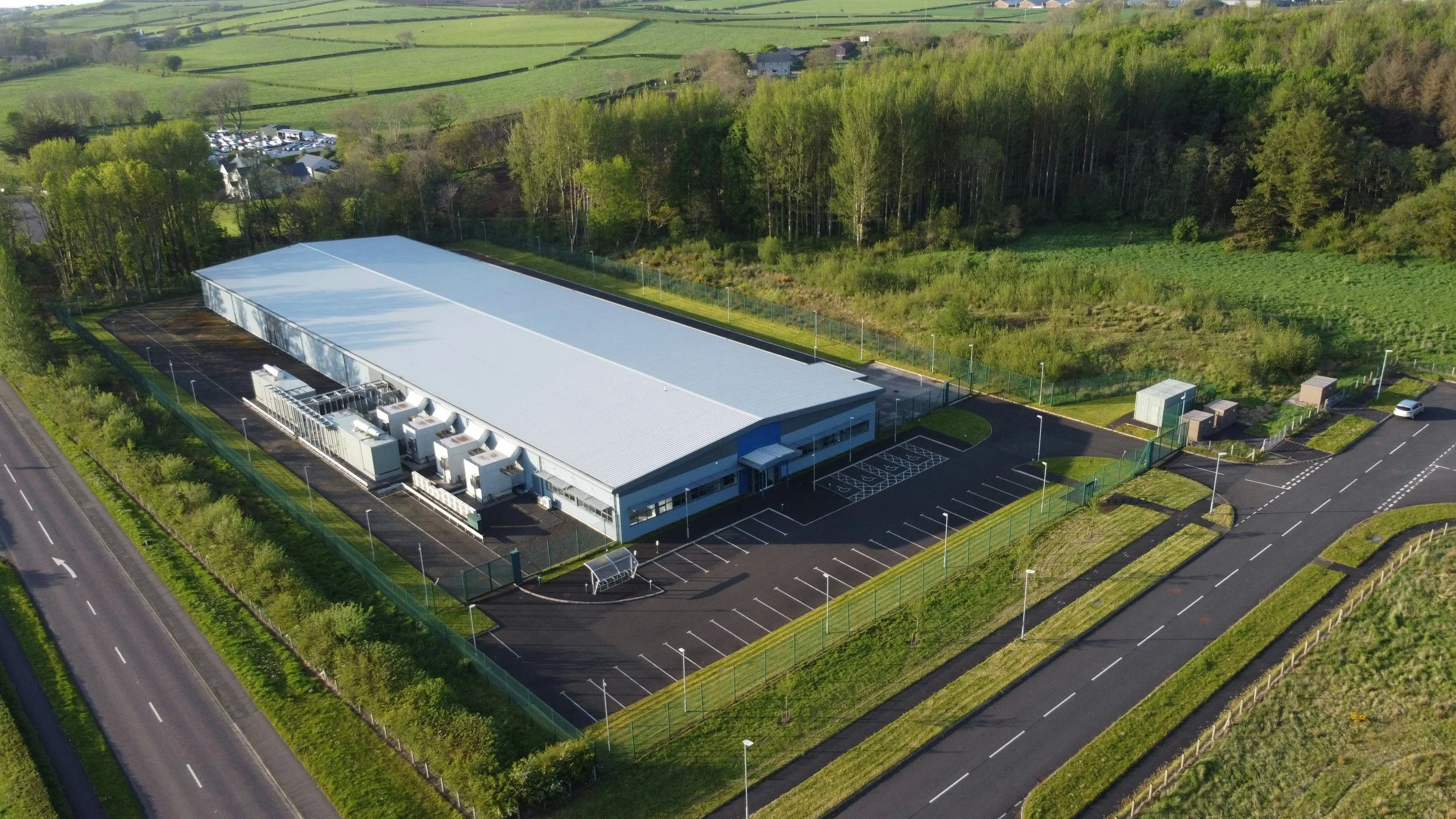
Georgia has been a popular state for new data centers due to the state’s tax incentives and its reputation as “one of the best” states to do business. Still, local Georgian communities have pushed back because data centers can disrupt communities, causing large volumes of water use for cooling, noise, electricity demands that drive up costs, and significant land use for construction. (Image: Geoffrey Moffett/Unsplash)
Recording from the Edges
Her field visits took her as far as Social Circle, home to one of Meta's largest campuses, where she conducted what she calls a light ethnography: walking, driving, listening and recording around the edges of the sites. The edges were as close as she could get. The facilities are heavily secured, ringed with no trespassing signs, with nowhere even to park. At the Meta campus, security turned her group away at the gate.
From the outside, she learned the noise is less a single roar than a layered system. Cooling towers, fans and ventilation units each produce their own signature, and some are easier to muffle than others. Generators stay silent until they switch on, then drown out everything else. Facilities closer to the city, she suspects, invest more in sound barriers and buried equipment.
The most unsettling discovery was infrasound, low frequency vibrations that the ear cannot register but the body can. Residents living near large data centers have reported migraines, headaches and sleep disturbances linked to it, though the phenomenon resists easy measurement.
"It's a little bit hard to pinpoint," Janicki said. "It’s hard to articulate, or capture, or measure."
She recorded it anyway, using an app that picks up low frequency vibrations, and folded it into the installation.
An Invitation to Rest
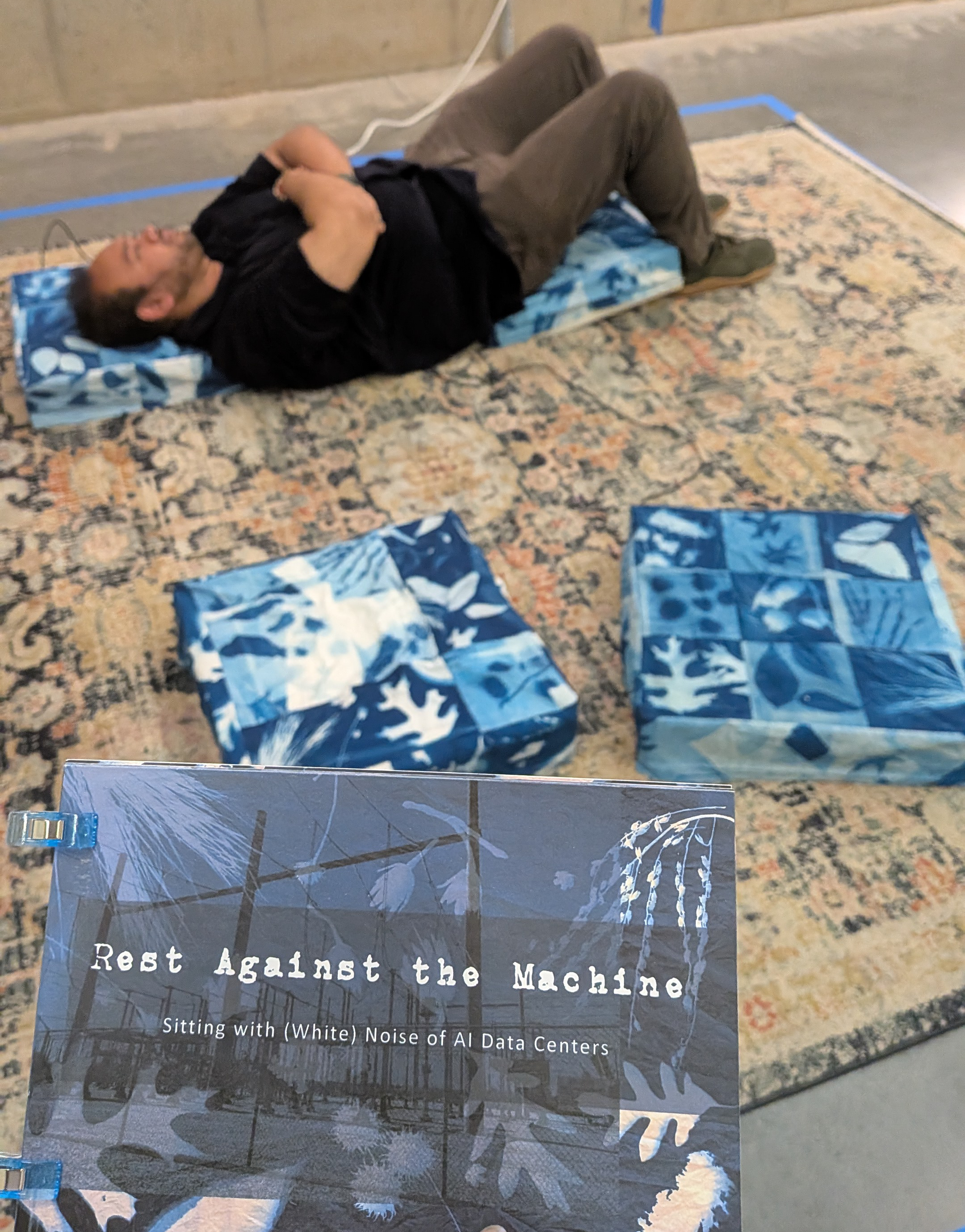
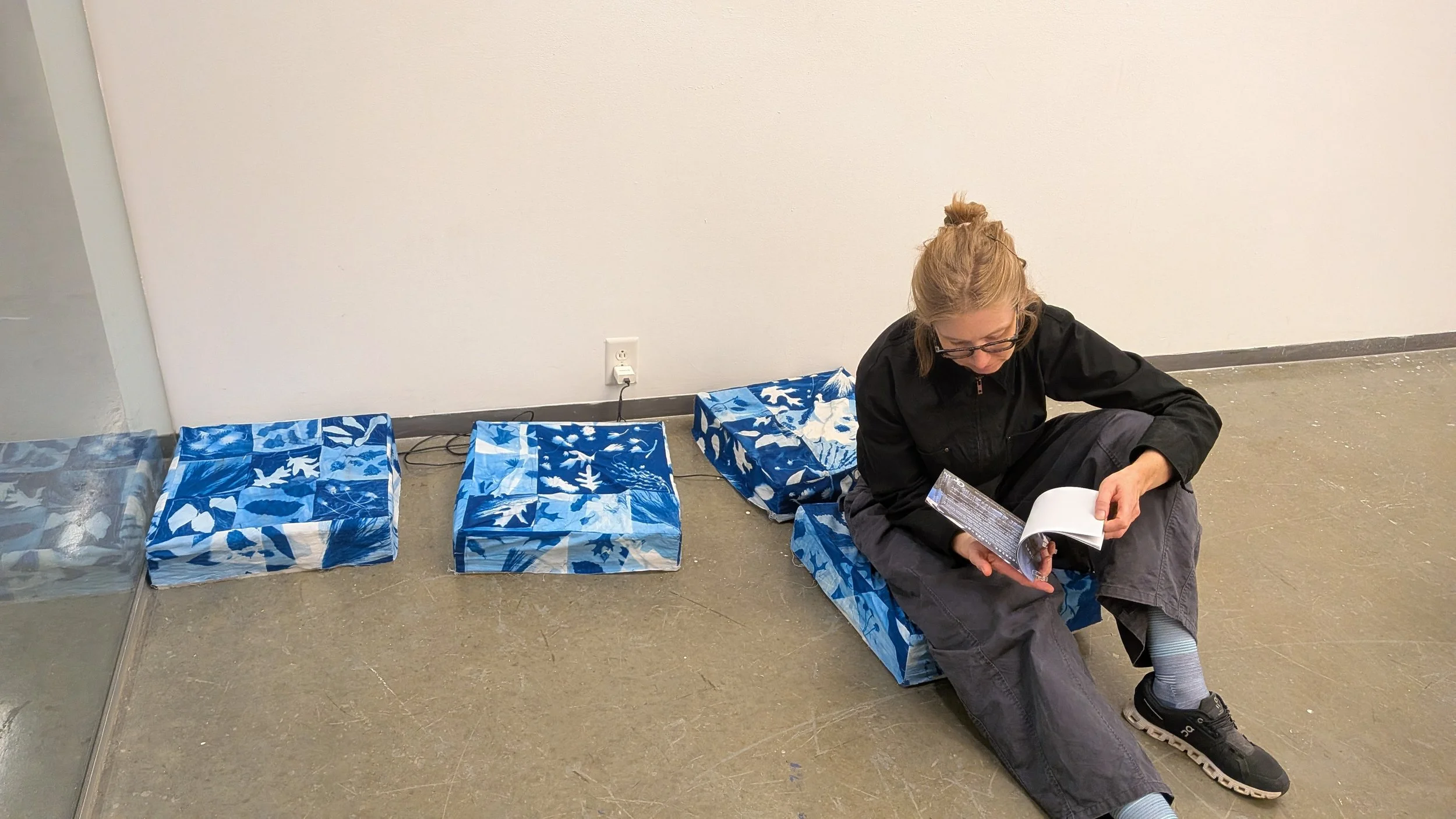
The installation itself turns those recordings into something disarmingly soft. Janicki processed the data center sounds into white noise, the same kind many people need to fall asleep, and embedded them in four cushions. Visitors are invited to lie down and rest. The fabric carries its own story: Janicki made sun prints from leaves, fruit and branches she collected from the ground beside the data center sites, recreating the landscapes that surround them.
The tension is the point. The sound soothes until visitors learn where it comes from, and then the conversations start.
"It sort of made a space for people to just sit together," Janicki said. "The noise is a probe, or a prompt even, to have a certain type of conversation around these issues."
Those conversations matter, she argues, because data centers are easy to ignore. Most rise in rural areas, out of sight of major population centers, where their impact falls heavily on a small number of neighbors.
"They're kind of out of sight," she said. "They're having a big impact on certain communities, but the impacts are not necessarily felt by most AI users."


Part of Something Larger
The project is ongoing, and so is the research behind it. Janicki is currently in Taiwan studying AI chip manufacturing as part of her broader work on the sustainability of AI infrastructure. She plans to exhibit Rest Against the Machine again this fall.
"There's a lot more to unpack in Georgia, with the rapid development of data centers ongoing now," she said. "There’s definitely a bigger story."