Making Advocacy the New Face of Data
In communities across the country, organizations are collecting data in record amounts, but the harder task is turning those insights into progress people can see and feel. Ashley Boone, an IPaT PhD candidate in the Human-Centered Computing program based out of TSRB, reimagines how we put our data to work. While working with nonprofits and analyzing citizen science projects, Boone studies how people collect data and how to more efficiently use these sets for advocacy.
“How can communities transform raw data into tools for change?”
Cities collect, catalog, and store vast amounts of information. However, city residents are rarely involved in the on and decision-making around that data. Boone's latest study, "Designing Tools for Data Activism," examines alternative methods for community members to engage in local civic participation. Posing the question:
“I work with community-based organizations that are using data to pursue some kind of social or political goal.” Boone describes. “My research is about understanding what kinds of data those organizations produce, what work goes into making that data, and then [understanding] how data becomes meaningful.” In this study, Boone collaborated with professors, researchers, and fellow PhD candidates to demonstrate how numbers can reflect a community and how a community can influence numbers.
She began her exploration with an unlikely case study: birds colliding with buildings. A conservation initiative called Project Safe Flight devotes its resources to tracking these collisions. For nearly a decade, Project Safe Flight has monitored bird-building interactions in the Atlanta metro area and has since expanded into Brunswick and Savannah.
Community members, described in the study as “citizen scientist volunteers,” walk urban routes during spring and autumn migration seasons. They log the species, locations, and conditions where collisions occur. Members of the public can also submit sightings through apps like iNaturalist and dBird. Their work has resulted in a detailed record of over 4,000 bird-building collisions in Atlanta. One of the goals of this data collection is to advocate for policy that would protect local birds. However, it can be difficult for citizen science projects to transition from data collection to data advocacy. Boone saw this as a critical gap. She recognized the distance between producing data and analyzing it productively. For Boone, productivity meant turning data into a tool for advocacy.
To test her notion that data can go beyond recordkeeping, Boone applied a method called Research through Design (RtD). This is a research tactic where the process of designing and making artifacts is used to generate a new understanding of a particular problem or area of interest. She conducted 20 interviews with volunteers, staff, and stakeholders. She also collaborated with a student team and experimented with new forms of analysis using Project Safe Flight’s data pool.
Instead of limiting the process to purely quantitative analysis, the group built, tested, and refined digital and physical tools that helped Project Safe Flight push for policy change. Three methods stood out.
The Data Compiler method, designed and built by Boone’s student James Kemerait, merged records from ArcGIS, dBird, and iNaturalist into a single dataset tailored for advocacy. Although the combined file did not match the strict scientific standards of Project Safe Flight’s scientific protocol, it still offered a fuller picture of the collisions’ impact on Atlanta.
This dataset carried enough weight to influence public opinion and decision-makers. The Social Media Visualizer, designed and built by another student of Boone, Ian Wood, automatically generates shareable graphics from collision records, giving Project Safe Flight a new way to amplify its message beyond less engaging scientific reports.
The third method, Collision Markers, designed and built by Jaeri Suh, created signs placed at collision sites. These markers made the problem visible to residents by linking data points to real places, calling attention to buildings that harm the most birds. Ultimately, this tool was not delivered to Project Safe Flight as feedback from their team indicated a preference for collaborative rather than confrontational activist strategies.
From these experiments, Boone drew three guidelines for effective data advocacy. First, she encourages communities not to wait for perfect datasets before acting. Even imperfect data can spark urgency. Second, she advises groups to welcome diversity across different datasets. Instead of restricting data collection to a single platform or tool, she demonstrates that combining diverse sources produces datasets that are well-suited for activism.
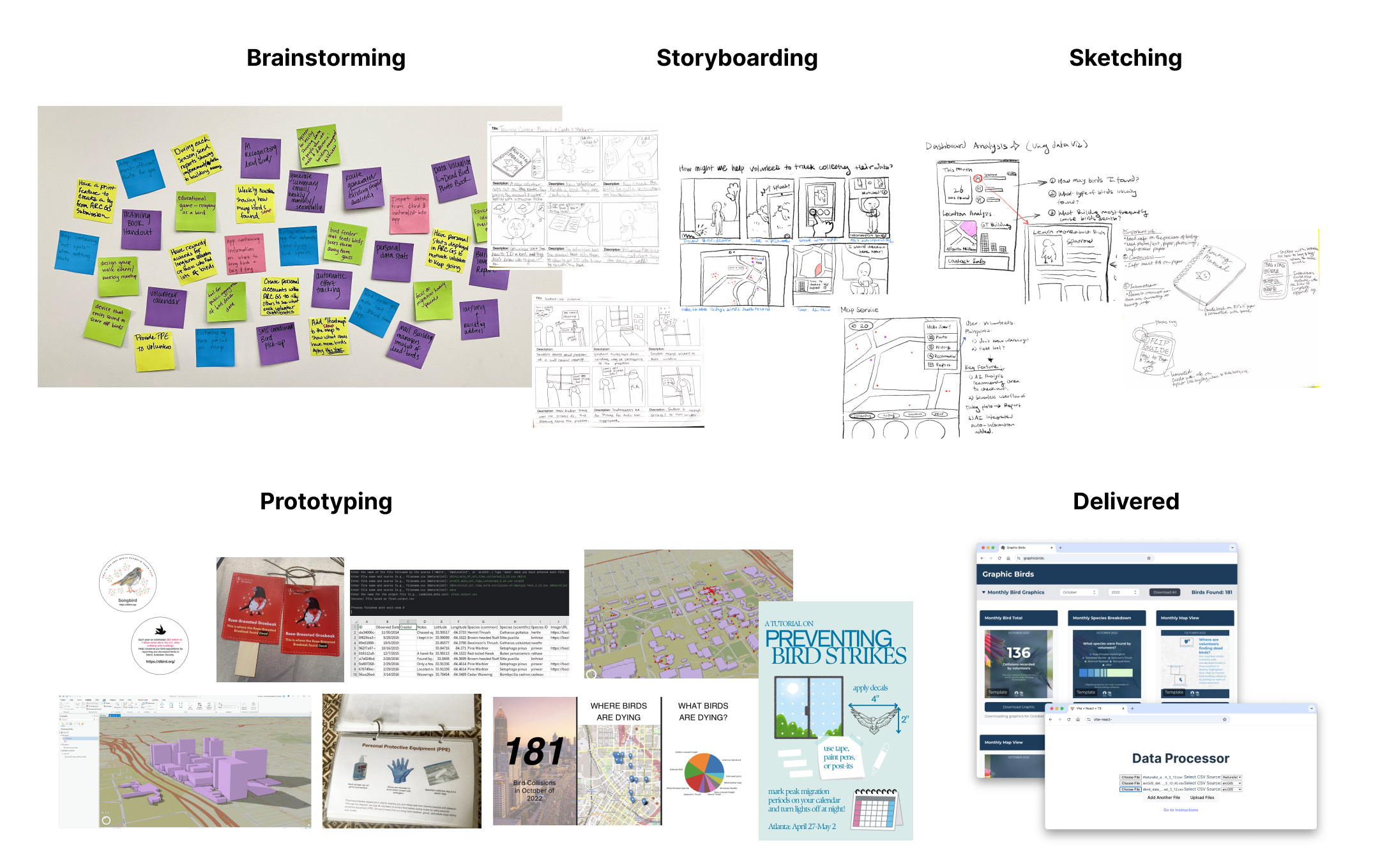
Image: Ashley Boone
Ultimately, she emphasizes the importance of fostering deep engagement. Manual tasks, such as searching for dead birds, inputting records, and reviewing collision sights, allow volunteers to build expertise and maintain strong community ties, essentially strengthening their advocacy. “People feel like they're learning, and so they want to keep participating.” Boone reflects. “Longer term participation starts to build a citizen scientist identity, and that's what keeps them involved.” Boone’s research delivers a broader lesson: data alone cannot create social change. Nonprofits and community groups achieve real impact only when they pair data with advocacy, organizing, and relationship-building efforts. Without that bridge, projects risk what Boone calls a “data production trap,” where groups collect endlessly without driving structural change.
“How do we make existing data matter?”
Although Boone focused on bird-building collisions, her study speaks to much larger issues. Civic organizations now face floods of open data, citizen science records, and crowdsourced reports. The pressing question has shifted from: How much data should we gather? to:
Boone’s research offers a blueprint and designs tools that amplify local voices, translate numbers into stories, and place communities at the center of their own evidence.
For Boone, the message is clear. “Having data isn’t enough,” she writes. “It takes tools, care, and people to turn records into action.” From spreadsheets of bird collisions to campaigns for safer cities, her research shows that data is not just a record of the world. From her perspective, data becomes a resource that, when handled with purpose, can help shape a better future. “We need to think about other ways of having an impact that are further than raising recognition or raising awareness. Because even if everyone's aware, that doesn't necessarily mean that anything changes.”