
Speculative Futures: Geometry, Light, and Legacy
In the bright, airy space of Memento, a curated gallery in Atlanta's Poncey-Highland neighborhood, Sam Thurman adjusts his intricate 3D-printed light sculptures, their pearly iridescence glowing softly against the studio's walls. The soft light cast by these fixtures hints at something beyond conventional design – a fusion of new technology, almost from a cyberpunk universe, and ancient symbolism. In June, those curious geometries found their way from campus to Memento, where Thurman’s joint debut show, Speculative Futures, with Mexican artist Ileana Moreno, invited techies and art lovers alike to imagine what happens when artificial intelligence and 3D printing meet sacred geometry and spiritual intent. “We do have a chance to save ourselves and we do have a chance for intention,” Thurman remarked during the exhibition’s opening, expressing his belief that innovative tools can be used mindfully to “move the human mind forward.” It’s an optimistic ethos that defines both Thurman’s personal journey and his work.
Sam Thurman stands at an unusual crossroads of architecture, technology, and fine art. He grew up in Lexington, Kentucky, where he developed a strong interest in both math and science. Thurman pursued architecture at the University of Cincinnati to merge his scientific aptitude with his artistic ambitions, later earning a Master’s in Architecture from Georgia Tech. He is currently completing a second Master’s in Urban Planning at Tech. As he progressed through his studies, he began to feel a shift in his focus. Reflecting on themes such as spirituality, technology, and their intersection, he started to see these tools as more than just instruments—they could serve as vehicles for deeper creative exploration and transformation. “Everything is a tool, and it depends on how you use it,” he says. “We can avoid being consumed by it.” This shift in perspective led Thurman away from traditional architecture, and his 3D-printed sculptures, originally a class project, grew into the cornerstone of his new career as an artist.
Thurman’s exploration of the intersection between technology and art began with his fascination for the potential of 3D printing. Initially conceived as part of a class project at Georgia Tech, his light sculptures became an extension of his evolving creative philosophy. “I started experimenting with forms,” he recalls, “but then I became obsessive.” What began as a design exercise soon transformed into a passionate pursuit, as Thurman realized that the tools he was using were capable of much more than simple prototyping. With each print, he discovered new complexities in the interplay of geometry and material, all while simultaneously pushing the boundaries of what digital fabrication could achieve. By using Grasshopper 3D, a design tool integrated with Rhino 3D, a standard 3D modeling software often used by architects, Thurman developed a custom script that generated intricate, radial forms, each one a unique expression of symmetry and precision.
A pivotal influence in Thurman’s artistic journey was Michael Gamble, a professor at Georgia Tech whose studio at Georgia Tech focused on exploring the imagination within space and form, specifically examining quantum mechanics and consciousness. Gamble’s emphasis on metaphysical themes, how thoughts and vibrations shape reality, resonated deeply with Thurman, sparking a new direction for his work. “I became obsessed with researching quantum mechanics and the patterns of etheric energy,” Thurman explains at the Speculative Futures opening reception, describing how these ideas influenced his approach to architecture. Pivotal to his growth was his independent interest and study of sacred geometry, a concept that intertwines mathematical and spiritual ideas, and has remained a core element in his design process. Through this lens, Thurman began to see design as a way to channel and materialize unseen energies into the built environment.
Thurman’s fascination with symmetry and geometry also stems from his admiration of Giovanni Battista Piranesi, an Italian classical archaeologist and architect, whose famous 18th-century engravings of an imaginary city, Campo Marzio, became a visual and philosophical inspiration. In Piranesi’s work, the boundary between ancient ruins and visionary architecture blurred, offering Thurman a model for creating spaces that were not merely functional but also spiritually resonant. “I wanted to transform the city into something spiritually charging,” he says of his pieces, which echo the same blend of past and future that Piranesi’s works invoke. Much like Piranesi’s detailed landscapes that blended the ancient with the speculative, Thurman’s work is an expression of both sacred geometry and new technology.

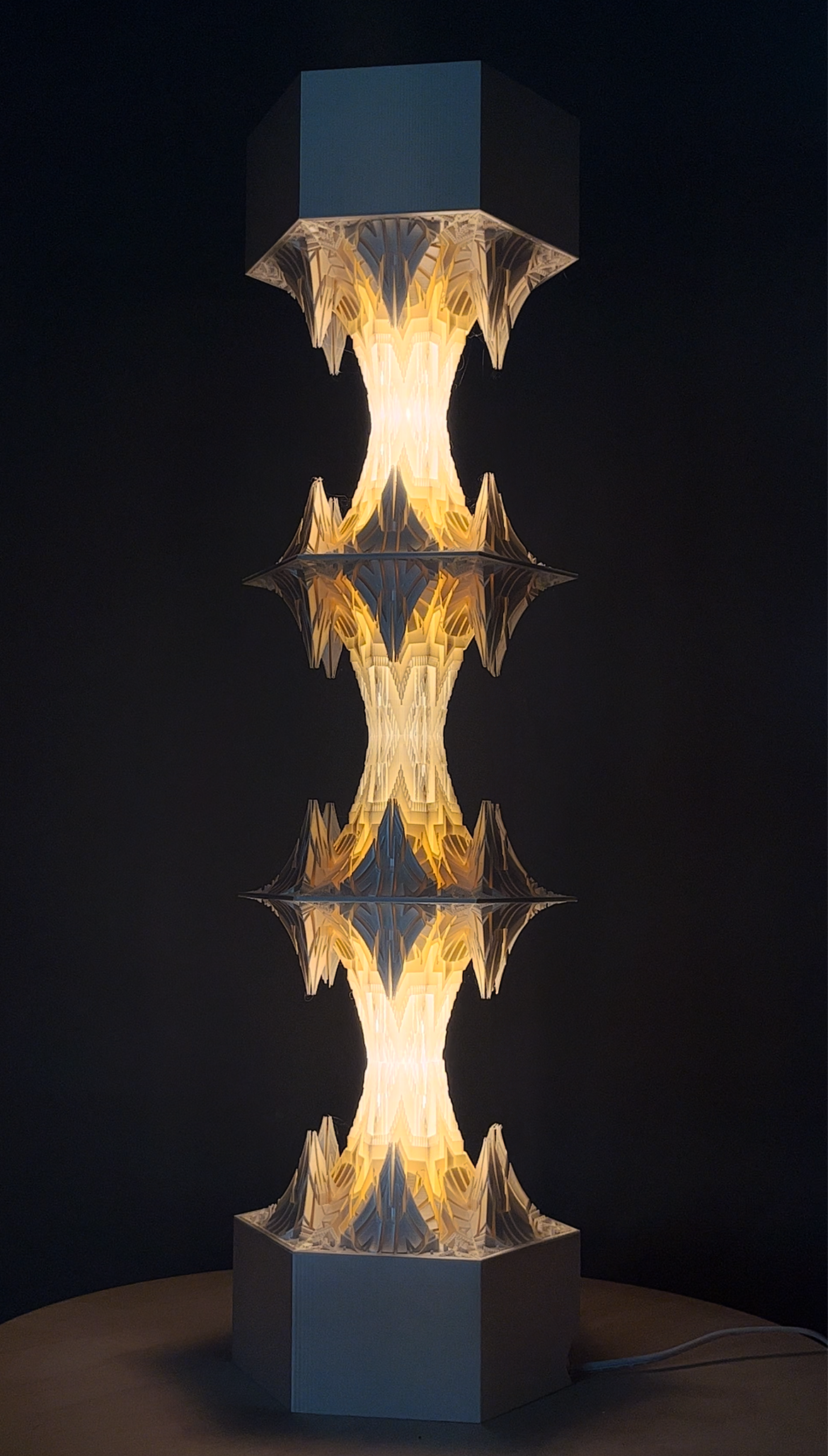
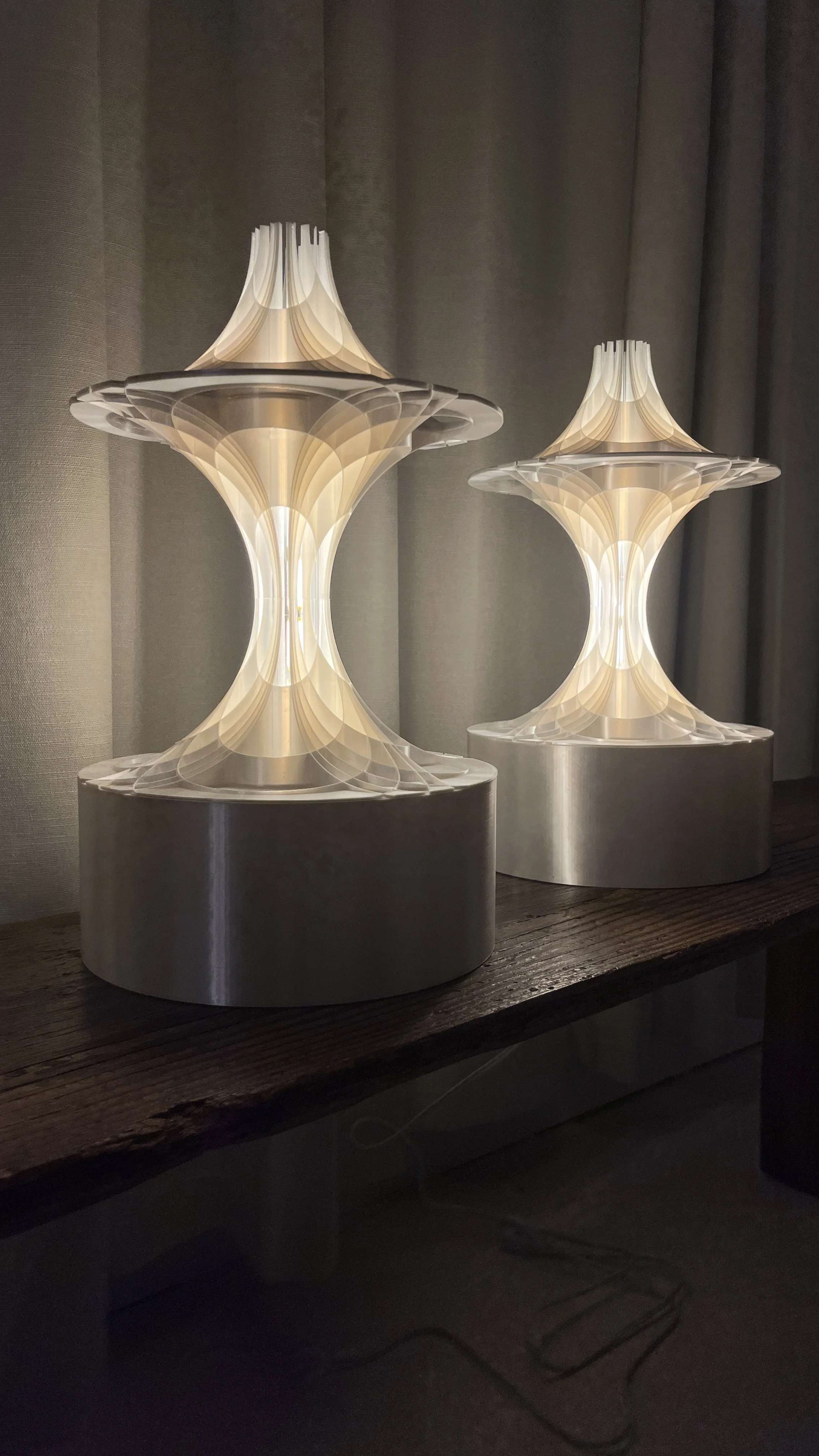
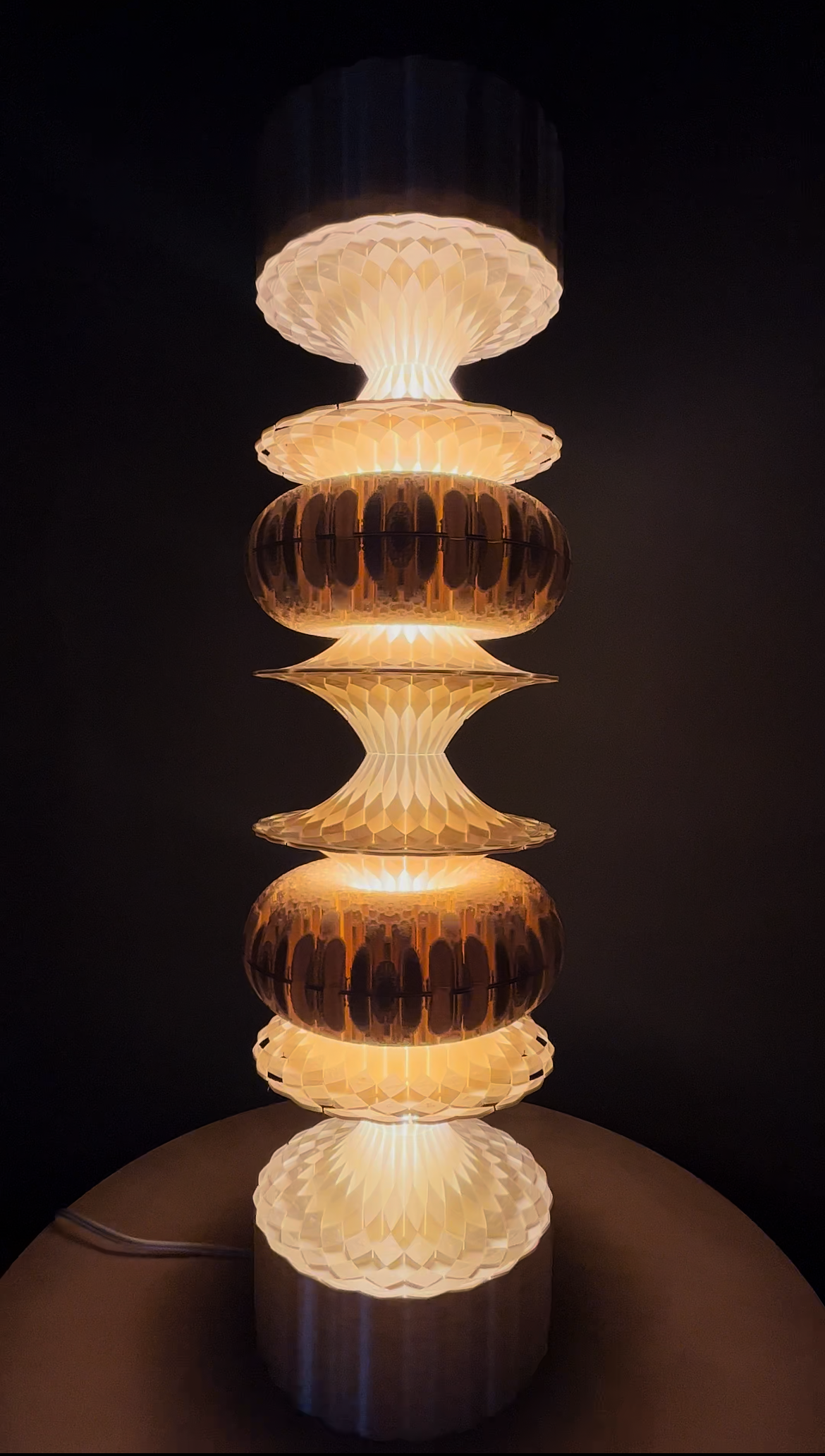
For Thurman, the geometric patterns in his light sculptures are more than just aesthetic choices; they represent his belief that form can influence energy and space. “Frequency is the architecture of reality,” he explains, reflecting on the philosophical foundations from his time in Professor Gamble’s studio. Thurman views these patterns as a way to channel energy, creating designs that are meant to resonate with the world in a more meaningful way. The shapes and proportions he uses, like Platonic solids and the golden ratio, are long associated with harmony and balance. For Thurman, they represent an intentional approach to shaping the environment. “While I’m happy to create something as practical as a light fixture, I also hope these pieces become tools to help shift the energy of the spaces they occupy,” Thurman continues, emphasizing his vision of the art as both functional and spiritually mindful.
While Thurman’s Speculative Futures exhibit at Memento has ended, those interested in seeing his sculptures can look forward to their upcoming display in Concourse E at Hartsfield-Jackson International Airport as part of the ATL Airport Art program this October.