
IASTMotion Addresses Physical Therapy’s Pain Point
A team of four students was in the zone. They had an idea in mind and an MVP in hand, but they were no longer in the lab; they were now in a clinician's office.
As athletes themselves, Andres Leon, who played soccer semi-professionally, and Ian Lee, who played baseball, these co-founders of IASTMotion had spent countless hours receiving physical therapy. But now, in the office surrounded by a prototype they had built, they were not patients receiving care from the physical therapists; they were looking to solve a common pain point for physical therapists.
“We noticed something: clinicians are constantly splitting their attention between multiple patients at once, unable to give any one person full focus, and it's only getting more frequent,” said IASTMotion’s co-founders.
IASTMotion has designed an automated device to replace the manual methods of how instrument assisted soft tissue mobilization (IASTM) is currently done, which is a hands-on and time-intensive therapy for muscles. These current methods use hand-held instruments and can take a clinic up to 4+ hours a day to deliver, can get compressed, or is replaced with less effective techniques as clinics try to keep pace.
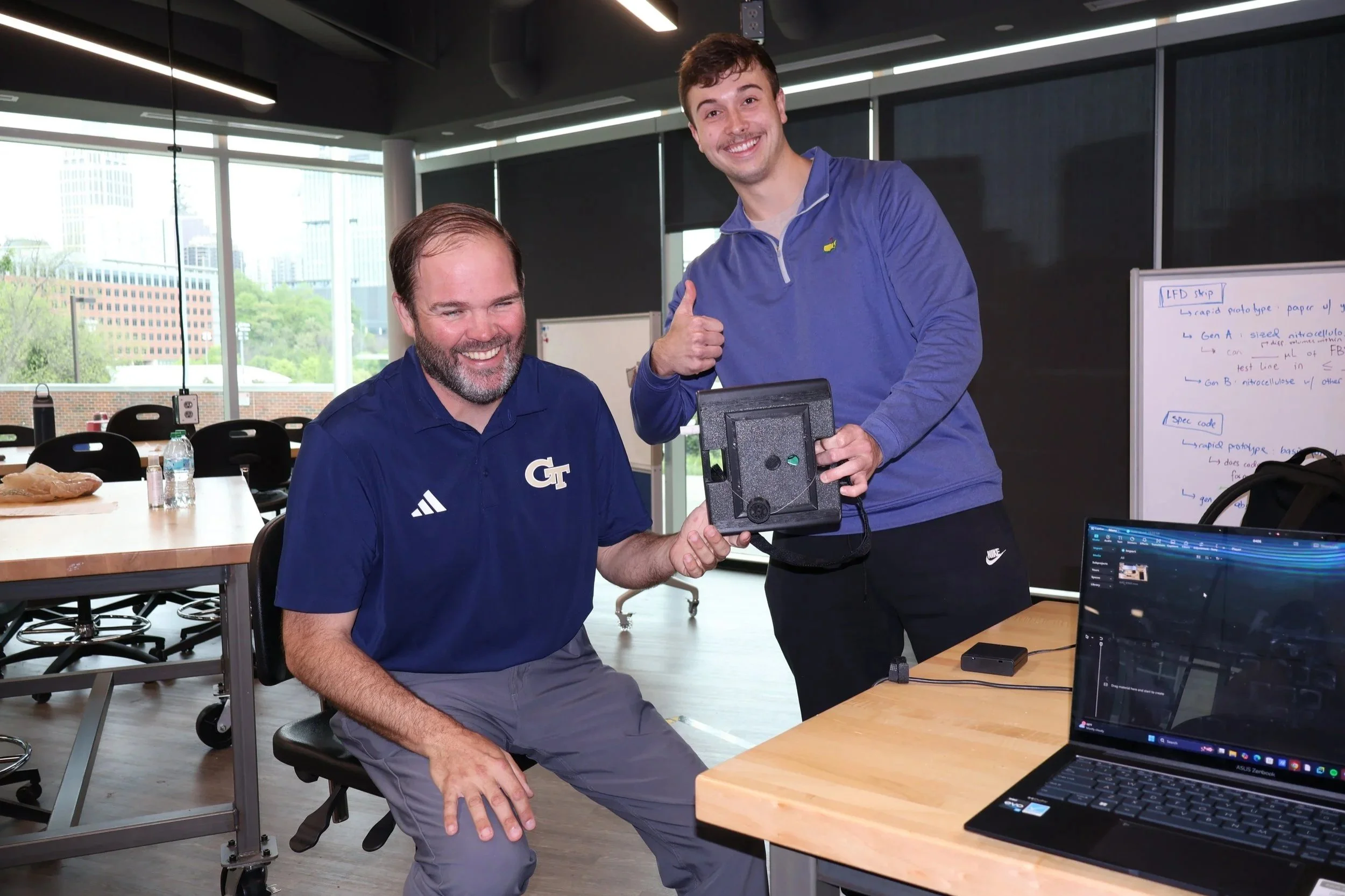
“We walked in, four students with this technology. We had replacement and spare parts on the floor. It looked like a mess when the physical therapists walked in. But then, as we were sharing what we’ve been building with our minimum viable product, our MVP, and as they learned, they became more interested and trusting of us,” said Leon, who graduated in August from the Georgia Tech Master of Biomedical Innovation and Development (MBID) program, which has a focus on commercializing bioengineered solutions for clinical application.
Meeting Physical Therapists Where They Are
Grounded in the understanding that the current, manual IASTM methods can be time-consuming for physical therapists, Leon and the IASTMotion team members, which include Ashwin Sequeira, Dev Patel, and Hayes Gill, acknowledged other challenges for clinicians. One is that physical therapists are also putting repeated stress on their own bodies, specifically musculoskeletal thumb pain, to do these manual therapies, which also don’t reimburse at a high cost with insurance. “It’s a high time and energy therapy for a low-cost treatment,” said Leon.
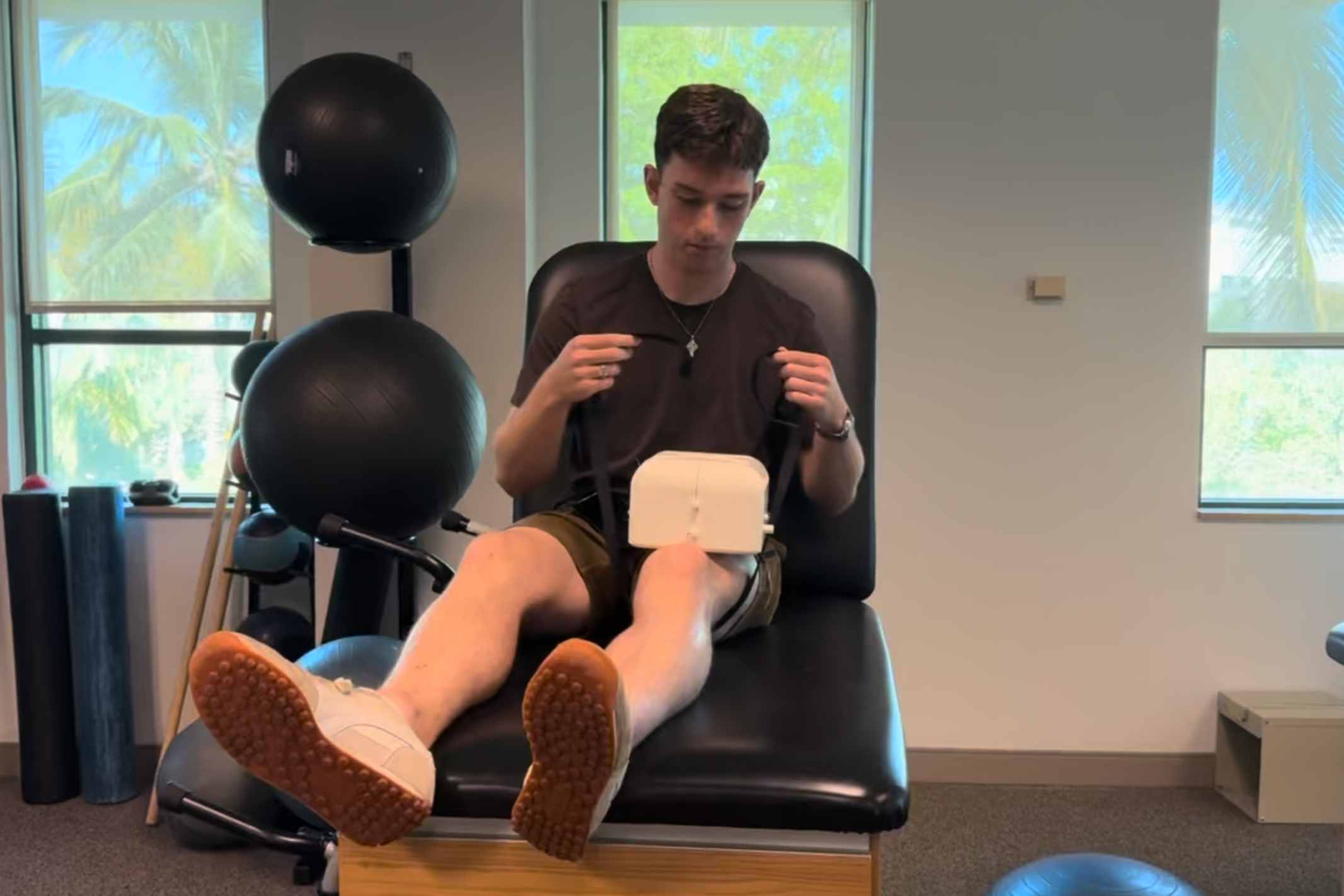
In the physical therapist’s office, the team shared the prototype that they had built with IASTMotion, an automated, remotely monitored mechanical device that replicates the manual process that physical therapists use for IASTM muscle tissue treatment. The prototype that the team built currently focuses on the quads, hamstrings, and calves for athletes, while the team may expand to other muscles based on feedback. Currently, IASTMotion’s device is designed specifically for athletes with strong muscle tissues, and is to be avoided for older people, those with blood clots, or patients who bruise easily.
With IASTMotion’s device, the physical therapists’ workflow is to first complete an evaluation of the muscles for knots as they have been doing, but then to use the automated IASTMotion device for the therapy in place of the manual therapy. IASTMotion’s device, which is to be used under the supervision of physical therapists, has an app that physical therapists can use to control the speed, direction, add pauses, or add stops for safety, which Leon shared is a top priority.
How MedTech Creates Meaningful Clinician and Patient Connections
As part of Georgia Tech’s CREATE-X Startup Summer 2026 Cohort, IASTMotion realized, thanks to their mentors, that just like practice before a game, they needed to test their ideas and get direct feedback from physical therapists and athletes.
“Our CREATE-X mentors encouraged us to go out and talk to people about their experiences and to do the ‘Mom Test’ for customer discovery. That got us the best traction,” said Leon.
“Before using the Mom Test, my questions for physical therapists were very specific. We had the MVP, ‘the baby,’ said Leon. “We made something we would have loved to have had in the market. But that doesn’t mean that it matters for the physical therapist and the market.”
A turning point for the IASTMotion team was adapting their customer discovery approach, using the Mom Test. “I approached the customer discovery discussions in a new way, asking more open-ended questions. Such as, ‘Walk me through your day-to-day?’ I also avoided yes-or-no questions and used the Mom Test questions,” said Leon.
The IASTMotion team has completed user interviews with 70+ clinicians and confirmed several key pain points, including that the physical therapy field faces a chronic practitioner shortage, which is projected to reach 8.2% by 2027, even as patient demand keeps climbing. In practice, physical therapists often manage three or more patients simultaneously.
As a result of this exploration and listening the IASTMotion team was able to update their MVP based on this new feedback, including related to encasing all wiring, adding handles to make the device easier to pick up and move, and adding real-time force sensor readings to show physical therapists and log the force applied at any given point.
IASTMotion has also tested their MVP, working closely with two athletic trainers who tested the technologies on themselves. Related to the athletic trainers who tested the device, Leon said, “They were very curious to see and feel how the IASTMotion device performed compared to manual IASTM, they are willing to try.”
From Concept to Commercialization
As Leon and the IASTMotion team developed a plan to meet with clinicians and patients and move from student innovators to trusted partners, they were aware that they would also need to conduct ongoing prototyping and testing.
They applied what startups call the “Looks-like, Works-like” approach for prototyping and piloting, which allows early-stage companies to explore ideas before committing time and resources to a technology. Using this approach, IASTMotion was able to implement the feedback they received and to share an updated version at the September 2026 CREATE-X Demo Day.
IASTMotion now has patent-pending technology, $40,000 in non-dilutive funding secured, 68 Letters of Intent from a clinic in Florida, completed Georgia Tech’s accelerator CREATE-X Startup Launch program, and has completed one prior accelerator USTAAR.
When pursuing commercialization of this idea, Leon said, “I’ve been working on the electronics and software, something I never thought I would be doing,” said Leon. Adding, “That’s the fun thing to learn a lot and work with mentors. You never know where you will end up.”
Leon acknowledges that pursuing FDA approval for medical devices is a long process. This process involves not only learning about the software and electronics, but also about managing risk, gathering data supporting the innovation, and raising funding to hit milestones.
Leon highlighted, “Our plan is to not replace physical therapists. Our plan is to help them better manage their patients.”
What looks like a technology that creates an automated and hands-off approach is really about deepening the connection between patients and physical therapists. With an automated device such as IASTMotion’s, physical therapists can focus their time, energy, and attention on what’s needed most: treatments that need more direct clinician review, keeping their businesses running, and conversations with patients.