
Teaching Sales AI What a Deal Really Means
The best salespeople carry a read on a deal that no CRM can see, a gut sense of whether it is alive or already lost long before the pipeline stage updates. Rishi Patel kept walking out of calls knowing exactly which deals were dead, then opening his CRM to find them all marked 70 percent likely to close by the reps. That gap gnawed at him for years before he did anything about it. Today, it is the founding premise of RevSage.ai, the emotional intelligence startup for B2B revenue teams that he is building through Georgia Tech's CREATE-X Startup Launch program with his co-founder Yogesh Raheja.
Rishi Patel, who spent a decade building systems that understand people, now leads RevSage.ai out of Georgia Tech's CREATE-X.
"Every sales leader I talk to is asking this one question every Monday morning," Rishi said. "And it isn't what did the customer say. It is, is this deal dead? If yes, how to revive it? Nobody's system is answering that."
A Decade Spent Teaching Machines to Understand People
Rishi earned an undergraduate degree in computer engineering at Mumbai University, worked across startups and consultancy projects, then pursued his master’s in analytics from Georgia Tech where he met his co-founder, Yogesh Raheja. All the while, he has chased a single question for more than ten years: how do we build systems that understand humans?
The insight that would become RevSage arrived in 2019, before ChatGPT made large language models a household concern. While at a previous position, Rishi was among the first to build an Indonesian language model, and fine-tuning it, he noticed something that stuck. "Human communication is really messy," he said, "with a mix of languages, a mix of emotions, cultural references, context. It can change a lot." Language understanding, he realized, was only the first step, and LLMs were stopping there. What interested him was everything underneath, the intent and behavior beneath the words. Humans, as he puts it, know more than they can say, and most of that lives in what he calls the tacit layer of communication.
Getting the Read
Rishi registered his first company in 2023, an AI assistant for meetings. It was, by his own assessment, a solid note-taker with a differentiation for the ability of immense customization in a field that already had strong ones. "The note-takers are good now," he said. "But they are answering what was said. It isn't a read, an actual read is missing. The thing that most salespeople do is not remember the call but knowing what the call meant."
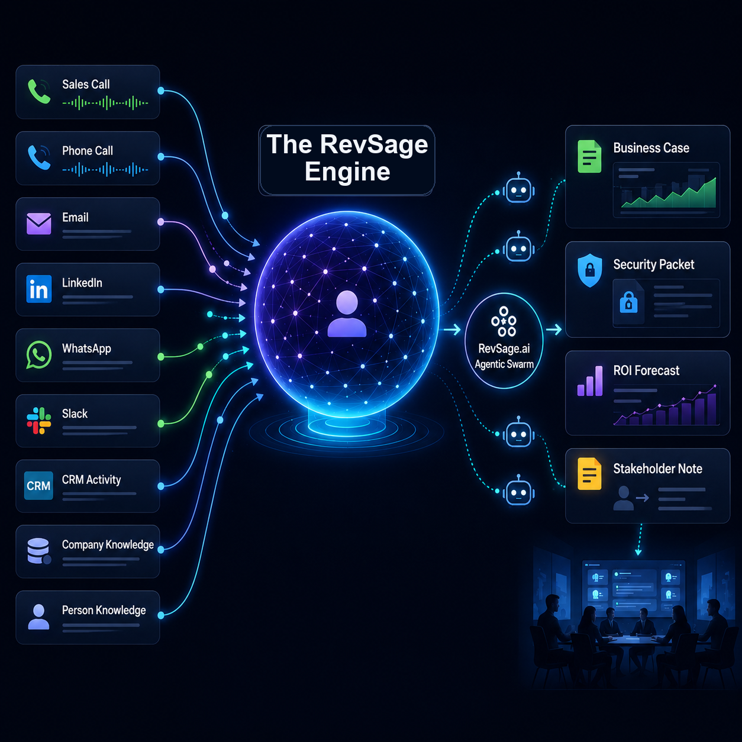
That distinction became RevSage. Rather than scoring words, the platform sets out to assist humans understand other humans, reading the emotion behind each question and response across the arc of a deal. It watches for signals that sit in plain sight but go unexamined: whether a buyer's questions grow deeper or shallower over three calls, whether a new stakeholder has entered the room, whether a reply time has stretched from a day to six weeks. "All of it is in the call," Rishi said, "but none of it is being analyzed." Underpinning the product is a data asset he began building with that first company, roughly 120,000 minutes of real sales calls paired with what happened after each one.

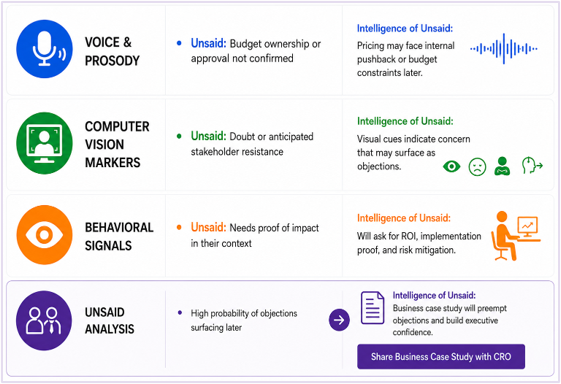
Voice Prosody and Computer Vision
A central piece of how RevSage reads a room is voice prosody and computer vision. Prosody refers to the rhythm, stress, pitch, and intonation of speech, the how of talking rather than the what. It is the difference between a sincere "I'm fine" and a clipped, frustrated one, and researchers have long noted that when a speaker's words and tone conflict, listeners believe the tone. Emotion AI systems measure these signals, pitch, loudness, and pacing among them, to infer states that words alone miss. RevSage layers prosody together with computer vision that reads micro-expressions and with plain behavioral observation, the kind of pattern tracking that needs no camera at all.
The CREATE-X Pivot
Patel found CREATE-X through a Georgia Tech alumni event and concluded RevSage belonged not at the idea stage but at launch, so he applied.
The program has reshaped RevSage's core positioning. The platform originally read a buyer's personality type, sorting people into frameworks like Myers-Briggs. Exposed to a steady stream of customer conversations, Rishi found that buyers bristled at being boxed in, and he shared their unease about the privacy questions that came with it. So RevSage stopped putting people in boxes and started putting deals in them. "The deal was put in a box, not the person," Rishi said. Because B2B sales involve multiple stakeholders, the shift also lets the platform read a salesperson's relationship with an entire buying organization rather than any single person. "CREATE-X opened a lot of avenues for us as a side effect," he said, "and we've found it to be really valuable."
Where RevSage Stands and Looking Forward
For now, RevSage is deliberately small and deliberately curious. Rishi and co-founder Yogesh lead a team of employees alongside a CRO, a product advisor, and a psychologist encompassing AI, business, sales, behavioral science, and product.
Customers spanning the United States, the United Kingdom, and India serve less as revenue than as data points, each a hypothesis the founders test before committing to a sector.
Rishi is candid that the company has not reached product-market fit and even when it does, it may never fully leave the discovery phase. "Good enough is not good enough," he said of the standard that CREATE-X pushed him towards. He wants customers who look at RevSage and feel it is exactly what they need.
But one early customer offered a glimpse of what "good enough" might eventually look like. After reading a RevSage report, the customer told the team: "This is exactly what I have been doing for 20 years. I just never knew how to do it at scale without getting tired."
That scale is the point. RevSage isn't built to replace a salesperson's read but to give the whole team the instinct of its best closer, before a meeting, during the call, and across every follow-up. A new rep walks into a conversation with the context of a veteran. A sales leader finally sees the signals that once lived only as a gut feeling.