
News & Research

Meet the Startup Delivering Emergency Medical Supplies with Drones
Reflex's mission is to save lives lost to slow response times by equipping bystanders with the necessary equipment and instruction to initiate the first response process. The startup is a medical drone delivery platform delivering life-saving supplies to the scene in time-critical emergencies.

Turning Down the Noise: CalmWave and Catalyst by Wellstar Aim to Cure ICU Alarm Fatigue
CalmWave is tackling one of healthcare’s most overlooked problems: alarm fatigue. By using AI to unify and analyze ICU monitor data, the Seattle-based startup helps hospitals reduce unnecessary noise, improve patient rest, and support clinical decision-making. Backed by Catalyst by Wellstar in Tech Square, Calmwave is bringing its “Quiet ICU” vision to life.

StrideLink Brings Gait Analysis Home with Wearable Tech
Most of us take thousands of steps each day without thinking, yet how we walk can reveal hidden health issues — something Atlanta-based StrideLink makes easier to track with wearable sensors and a smartphone app, replacing costly, bulky gait labs with portable, lab-quality analysis.

Turning Smartphones into Lab-Grade Microscopes
Professor Alexander Adams, founding director of Georgia Tech’s Uncommon Sense Lab, began his career in music before transitioning to engineering. Fascinated by sensing systems and human-computer interaction, he now leads research on using everyday devices for advanced healthcare applications.

Rosa Arriaga’s Research Advances Tech Design for Continuous Chronic and Mental Health Management
In today’s healthcare landscape, continuity of care is often disrupted by fragmented systems, lack of engagement, and limited data integration between clinical visits. Dr. Rosa Arriaga, a researcher in Human-Computer Interaction (HCI) at Georgia Tech, is pioneering ways to bridge these gaps through innovative technology-driven solutions.

Empowering Women’s Health: Discover Lilypad’s Innovative Screening Solution
Lilypad Health aims to destigmatize menstrual health and care, allowing people to not only talk about their experiences but also access the care they need. Lilypad’s technology is a non-invasive menstrual pad add-on that acts as a collection device to test for health markers such as like Thyroid hormone levels, A1c, fertility hormones, and HPV.

Envisioning a Smarter Stethoscope
What if a low-cost, micro-sized patch could provide more accurate and accessible data by capturing acoustic fingerprints of the heart and lungs? StethX Microsystems is revolutionizing hardware for medical device solutions such as wearables. StethX’s acoustic sensor works as a smart stethoscope, picking up acceleration data and using AI or machine learning to detect disease or impending events.

Doing a 180°: GlucoSense Transforms Diabetes Care
A person with Type 1 diabetes makes an average of 180 lifestyle choices every day. Whether it's skipping a workout, going out with friends, or staying up late to study, every decision for a diabetic must be intentional. GlucoSense collects information from users' fitness trackers, insulin pumps, and continuous glucose monitors (CGMs) to synthesize the day's data all into one place, making it easier for diabetics to understand how their lifestyles impact their blood sugar levels.
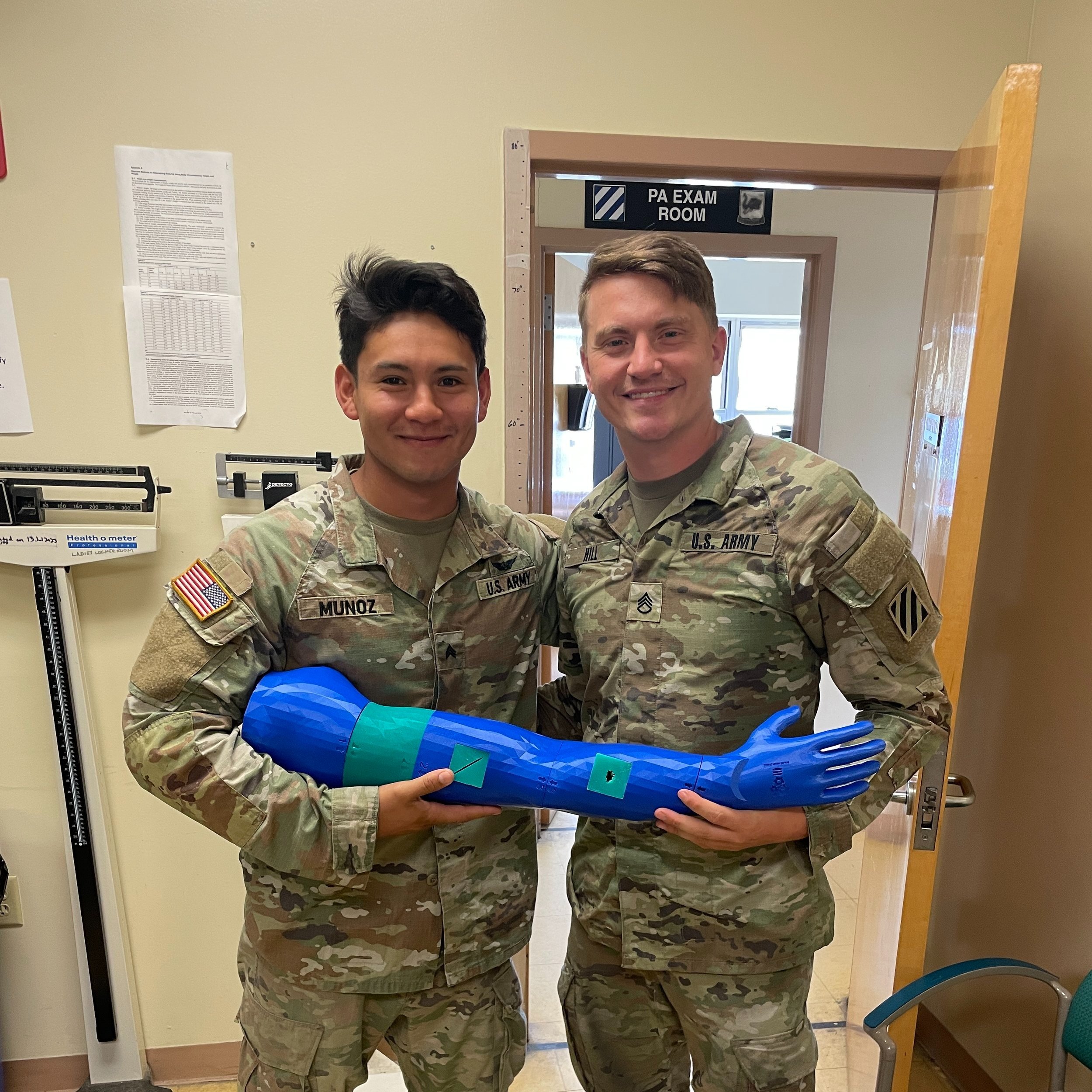
This Atlanta Startup 3D Prints Arms to Better Train First Responders
In the TSQ ATL Clubhouse in the heart of Tech Square, five 3D printers constantly buzz to create lifelike, plastic arms. Rapid Deployment Medical Training (RDMT), founded by Joseph Ashley and Cole Malenich, helps medical professionals, first responders, and military personnel better prepare for emergencies.

Stride Labs Redefines Orthotic Care with AI-Driven Tech
Stride Labs revolutionizes orthotic insole design by integrating technology and ergonomic principles, using AI to fully automate the process using 3D scanning, and offering custom solutions for various foot conditions.

MapHabit Bridges Gaps in Cognitive Support
Inspired by personal experiences with Alzheimer's and Down syndrome in his family, Matt Golden, along with neuroscientist Stuart Zola, Ph.D., created an evidence-based platform to improve the well-being and autonomy of individuals requiring cognitive support and their caregivers.